Original Works & Spatial Interventions
Curvism
Beyond the Rectangle
Original Paintings, Articulated Canvases & Spatial Interventions
What happens when painting refuses to remain inside the rectangle?
Federico García Sala explores this question through paintings constructed from interconnected, articulated canvases. These works can extend beyond the conventional picture plane, bend across architectural corners and transform the relationship between artwork, wall and viewer.
Curvism is not simply about painting curves. It is about questioning the boundaries that determine where a painting begins and ends.
Federico García Sala trained at the Arturo Michelena School of Fine Arts in Valencia, Venezuela, and now works in England. Artist biography
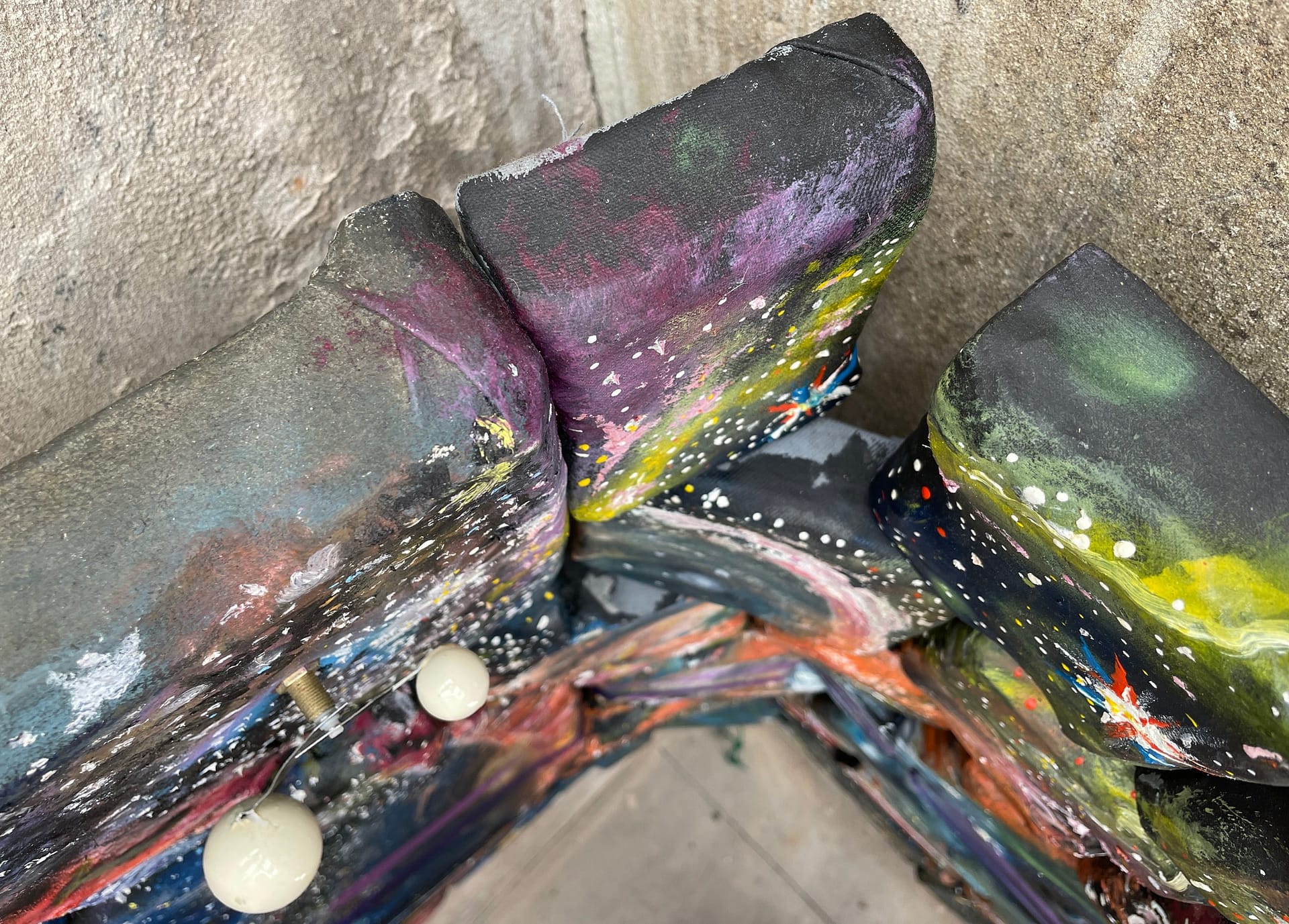
- Articulated, interconnected canvases
- Stretchers joined with screws, bolts and hinges
- Displayed flat, curved or across corners
- Oil, pigments & beeswax
The Question
Why must a painting remain rectangular?
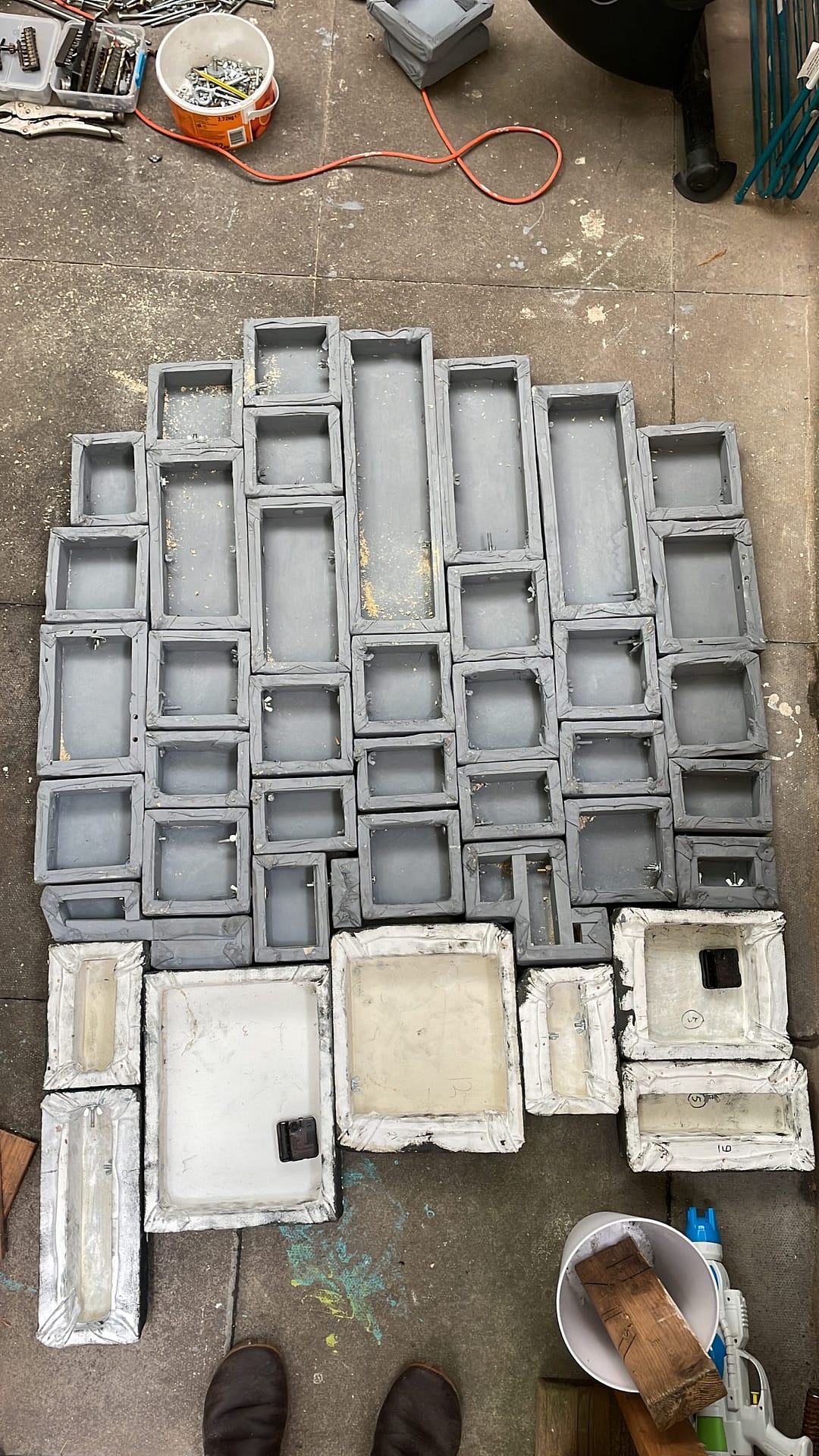
For centuries the picture has been a flat rectangle hung on a flat wall. Curvism treats that format as a convention rather than a law. Each work in this archive is built from many smaller stretchers — joined with screws, bolts or hinges — so that the painting itself can open, fold and follow the architecture instead of ignoring it.
“Uniting many squares and other geometric shapes could explain how to get out of the rigidity of the square frame.”
— The artist, on Rosa britannica
Breaking the Frame
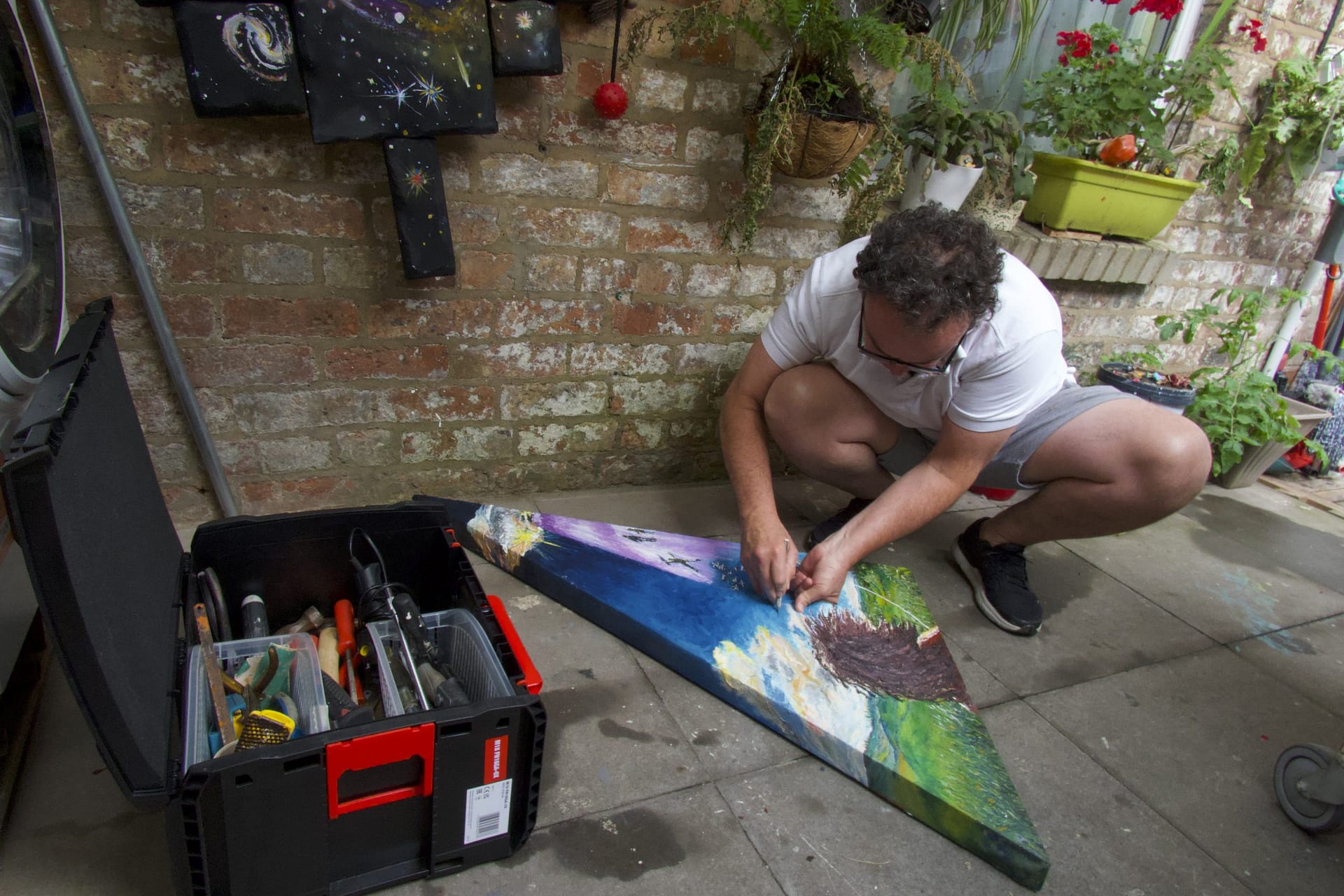
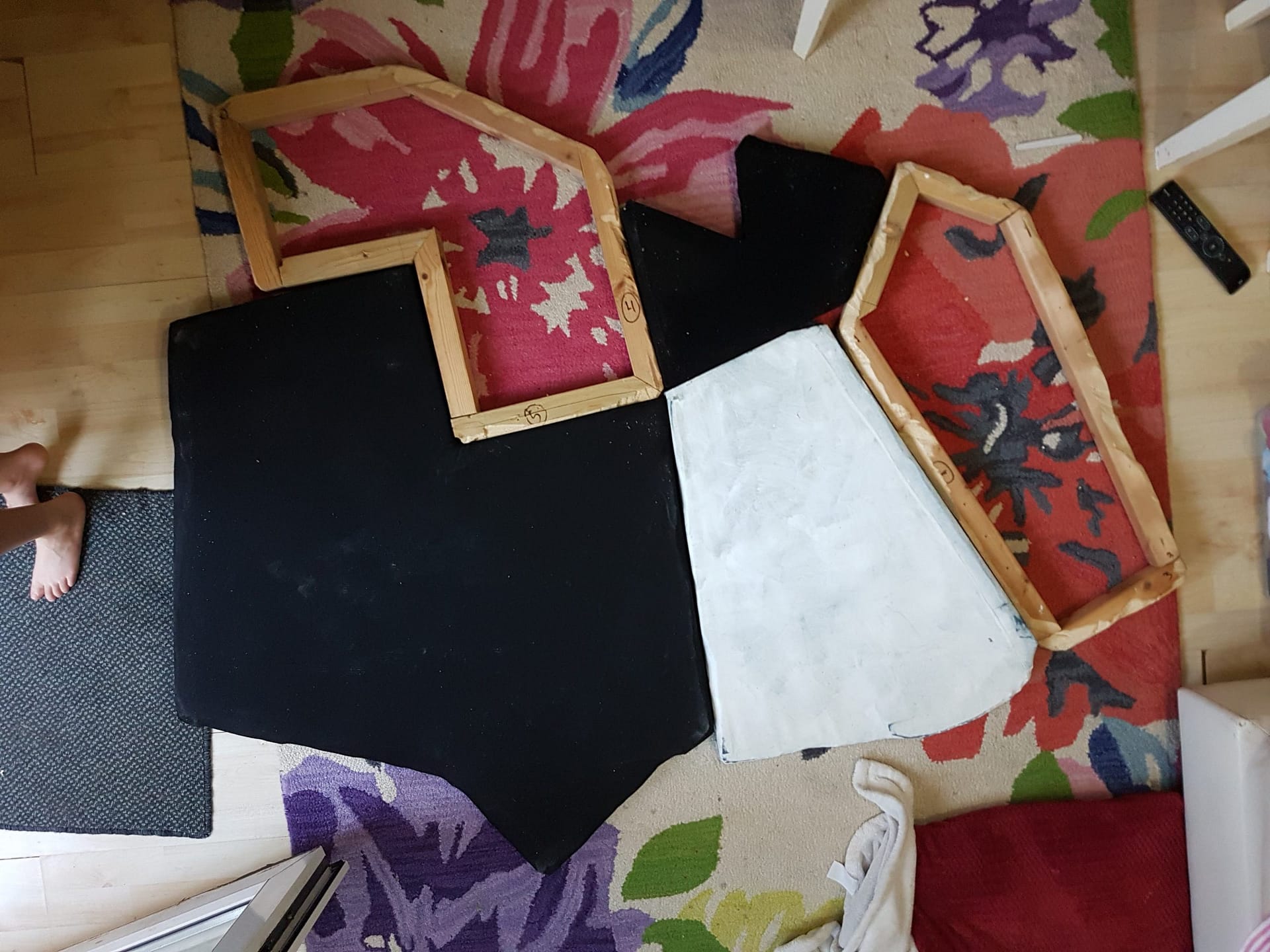
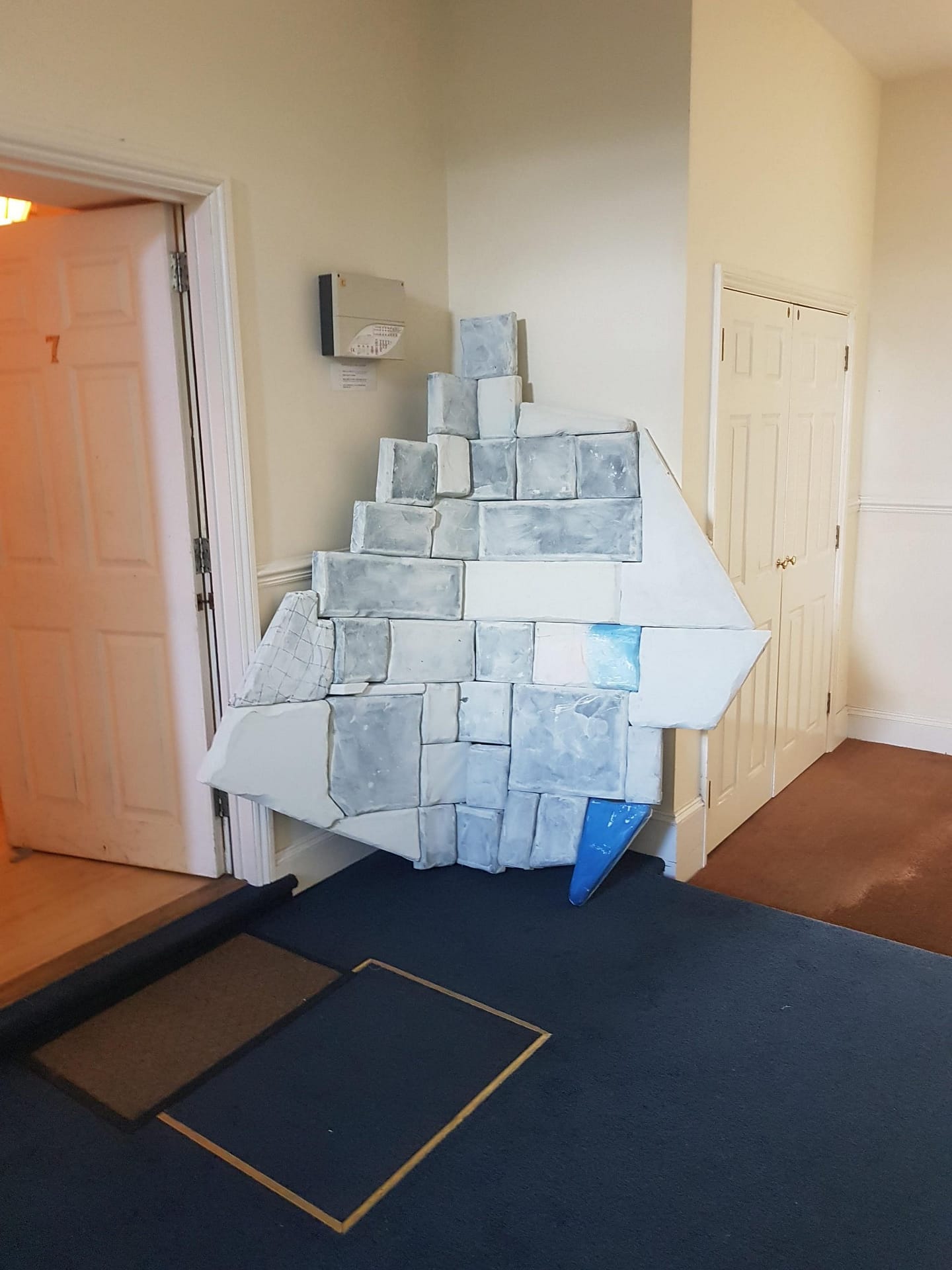
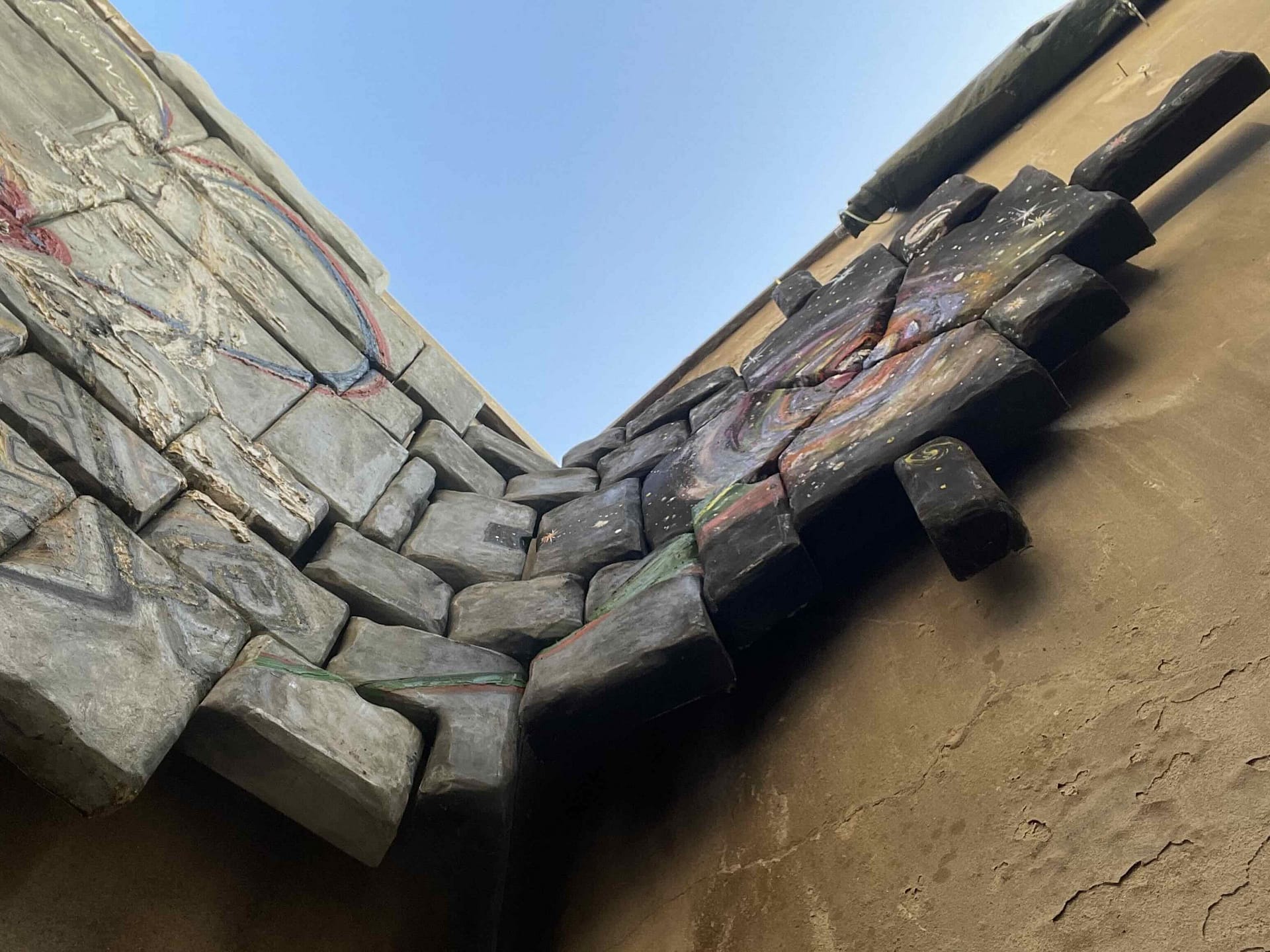
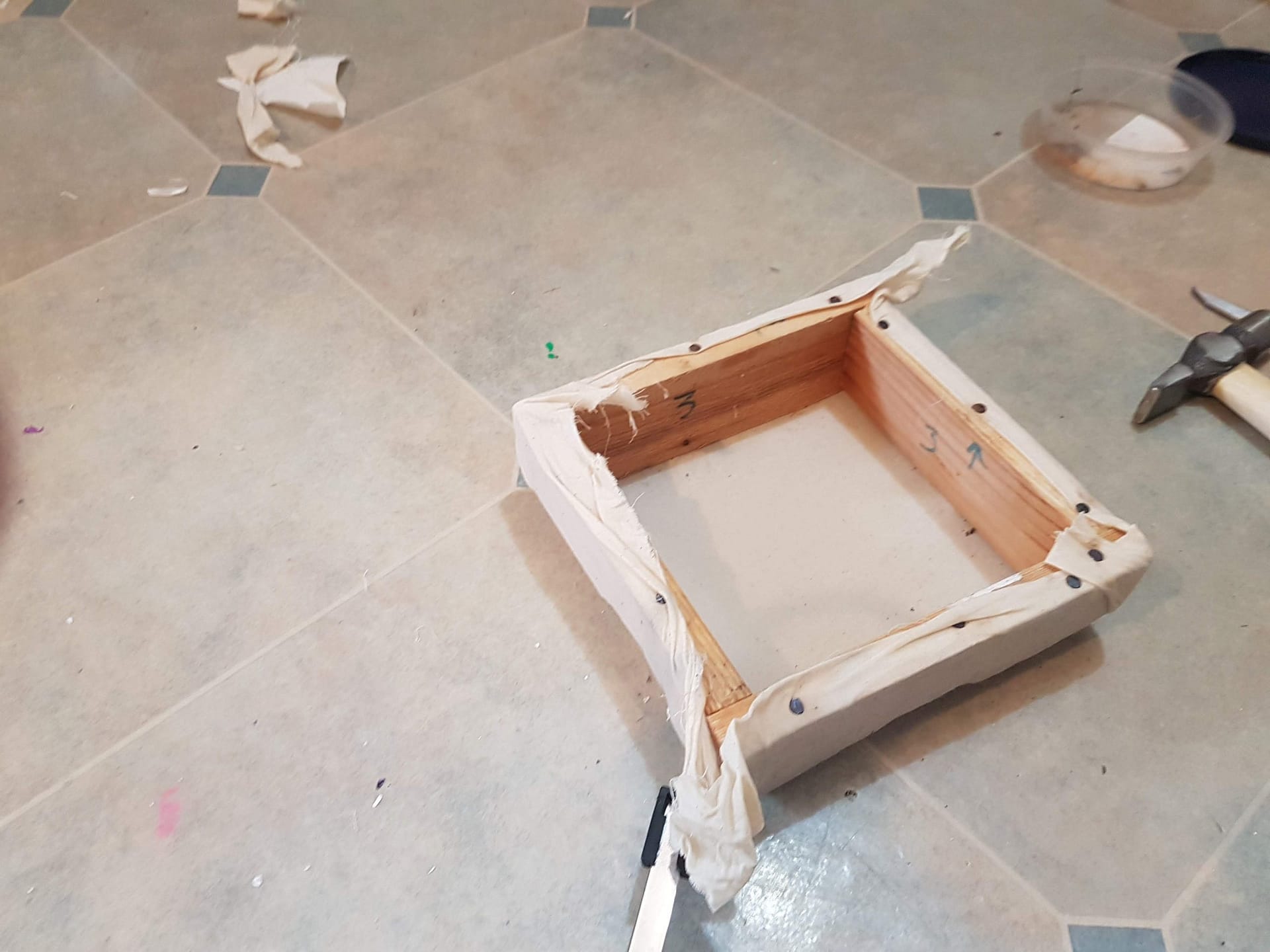
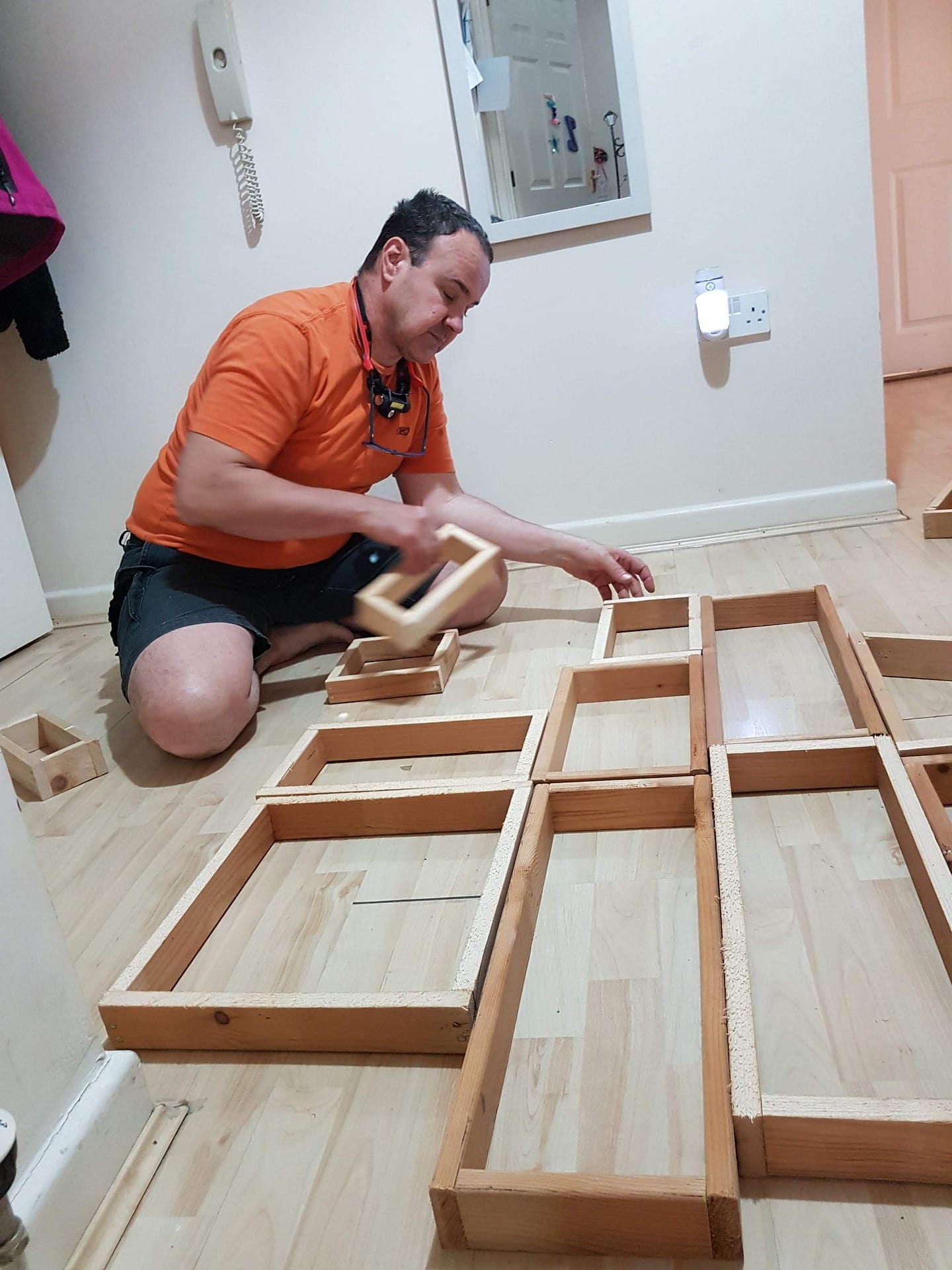
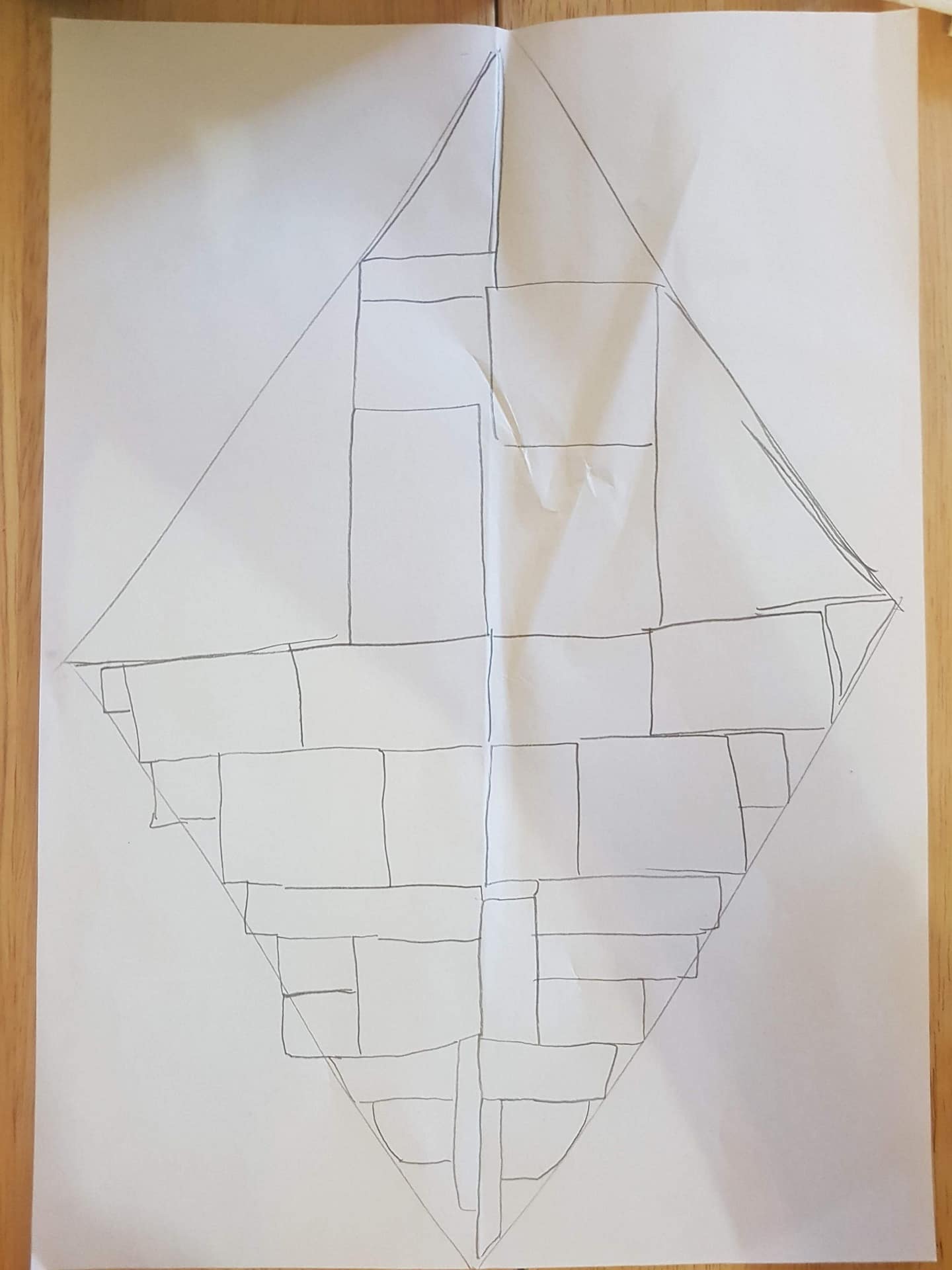
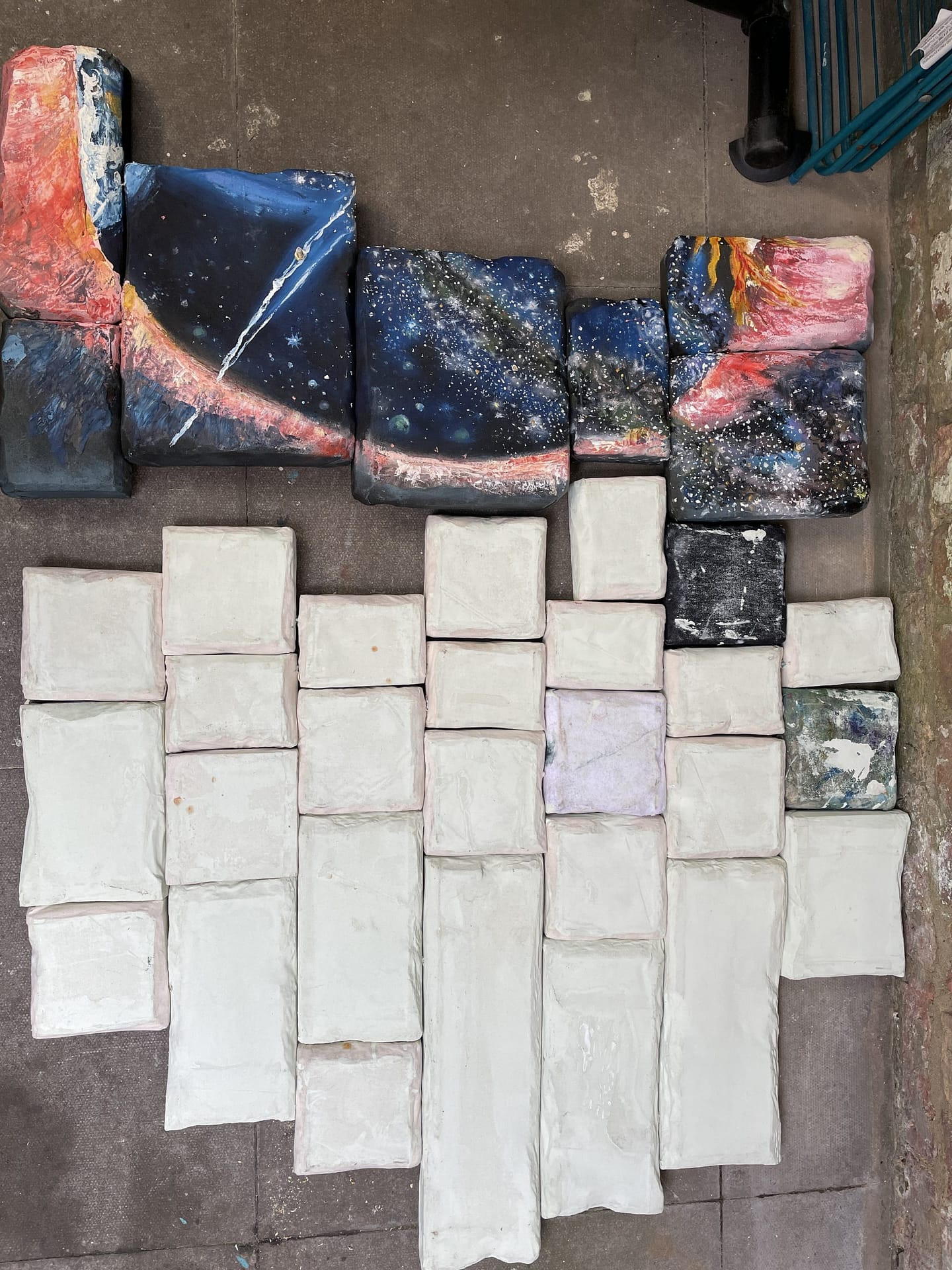
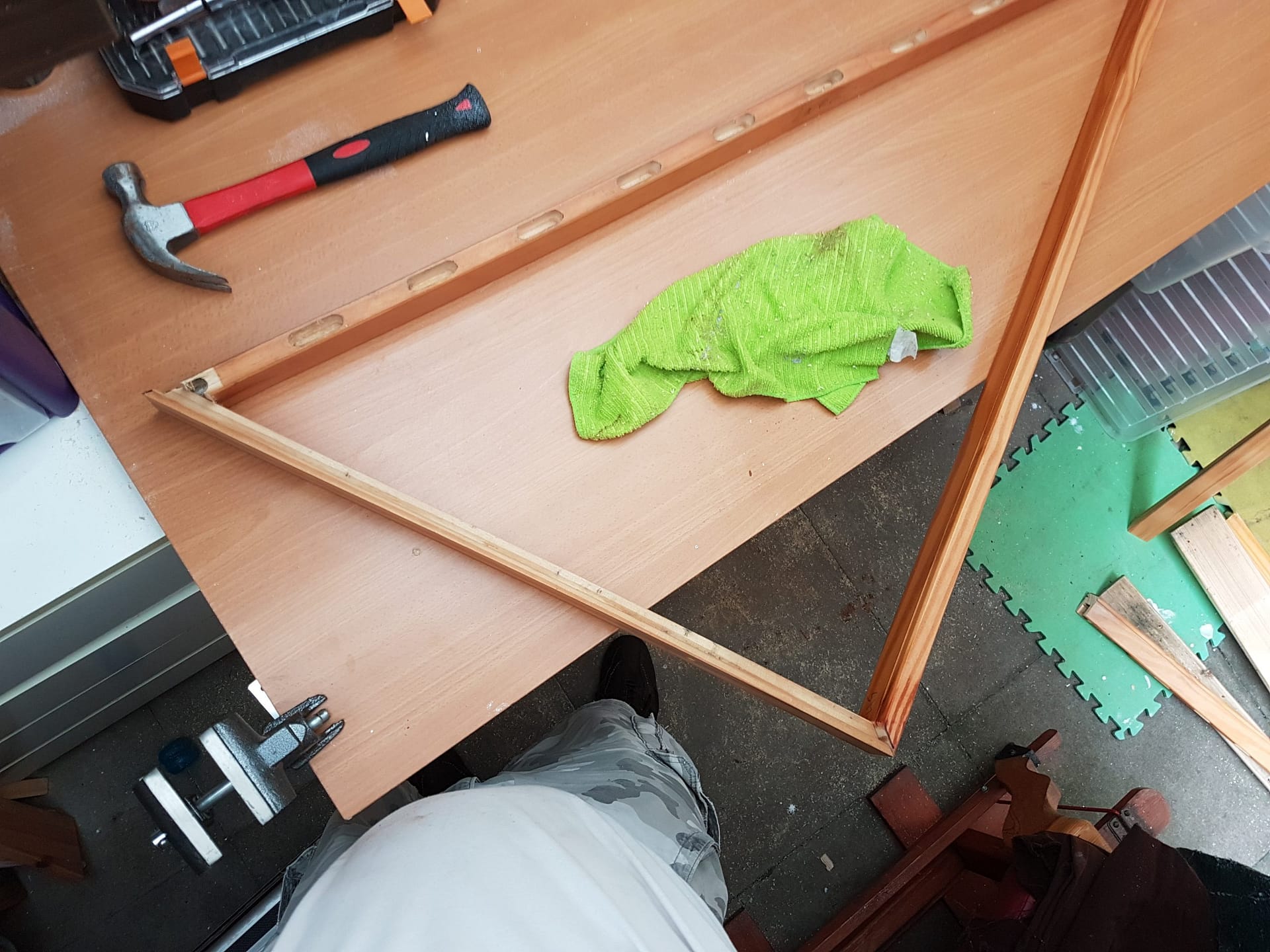
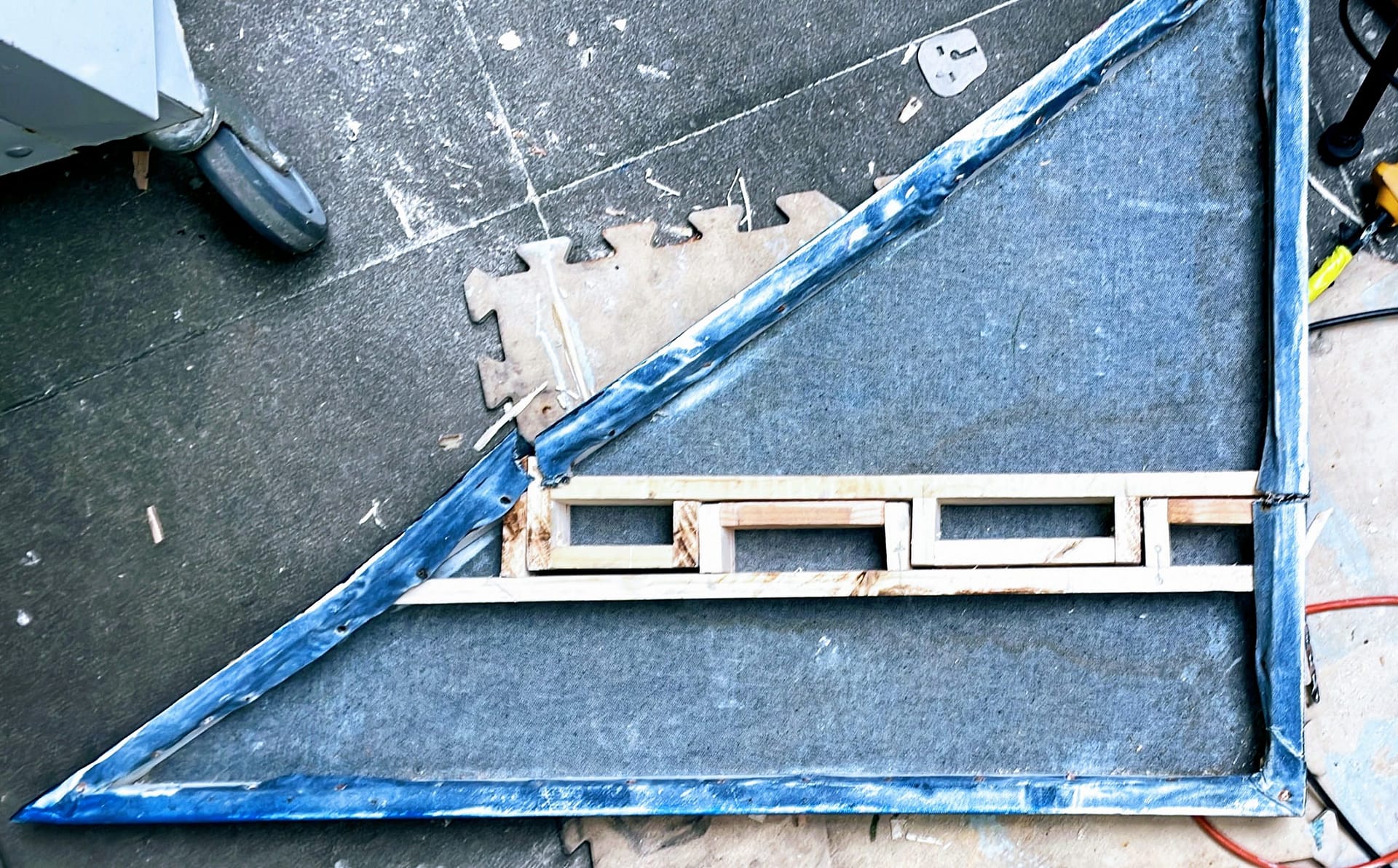
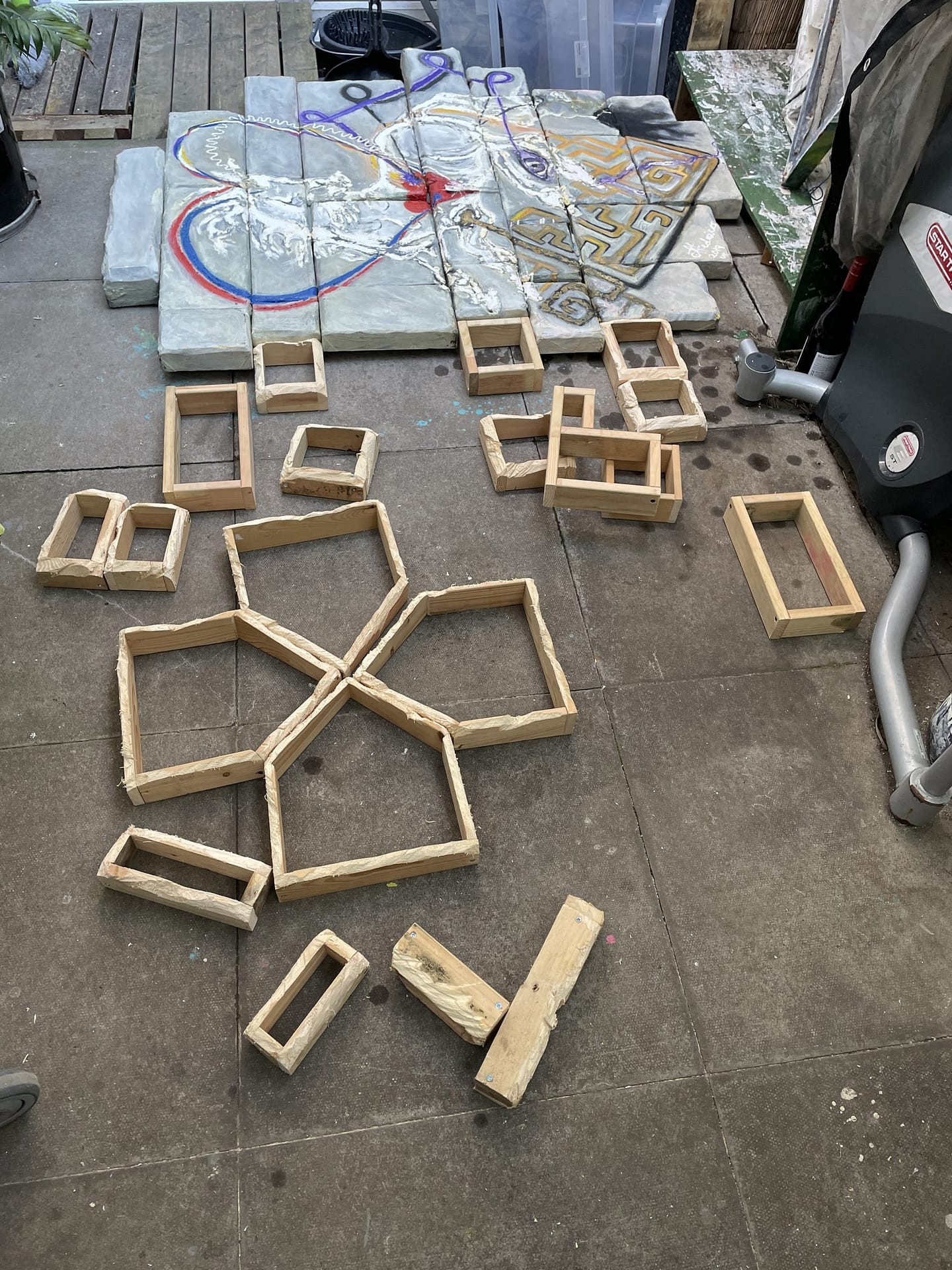
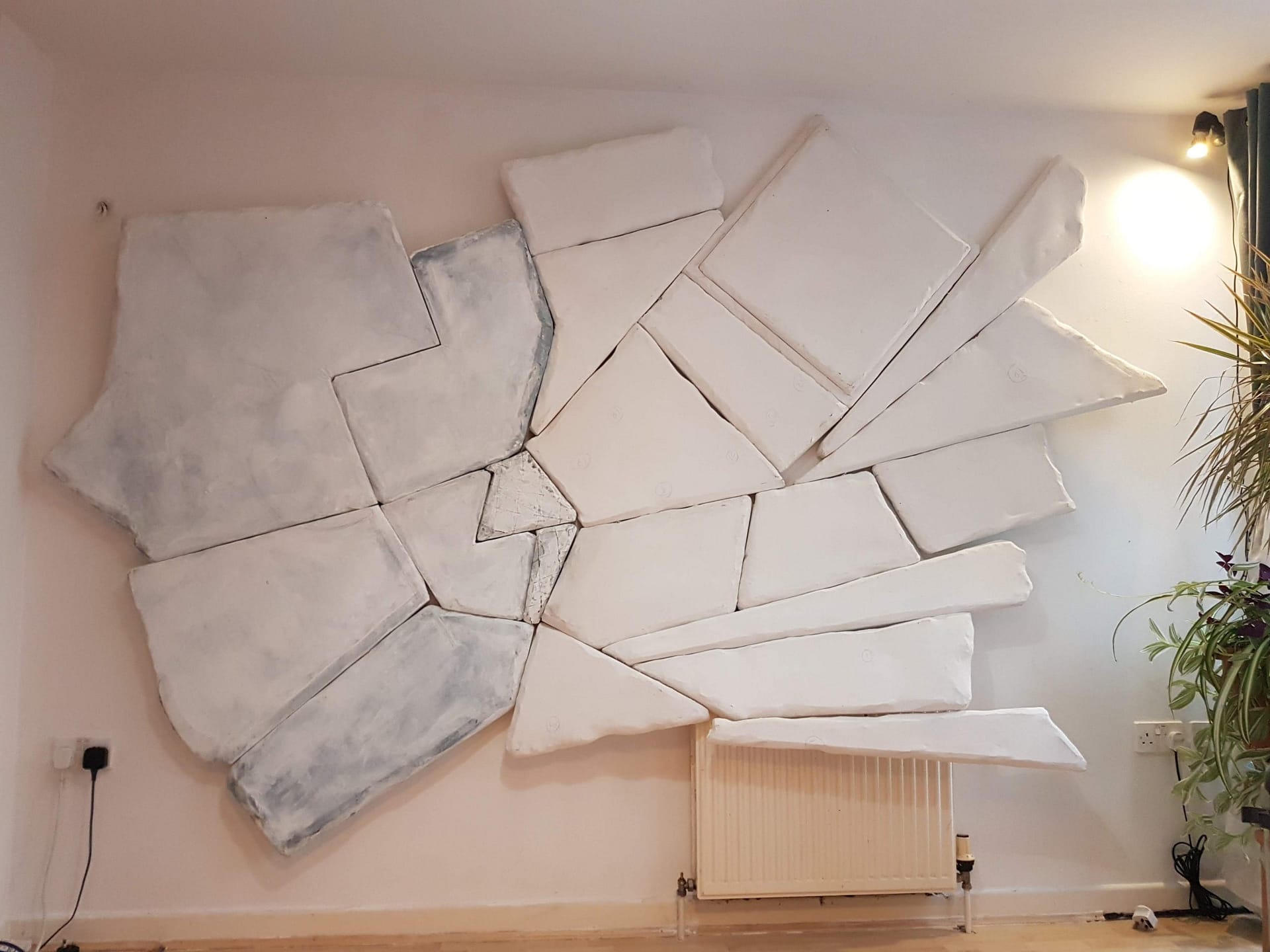
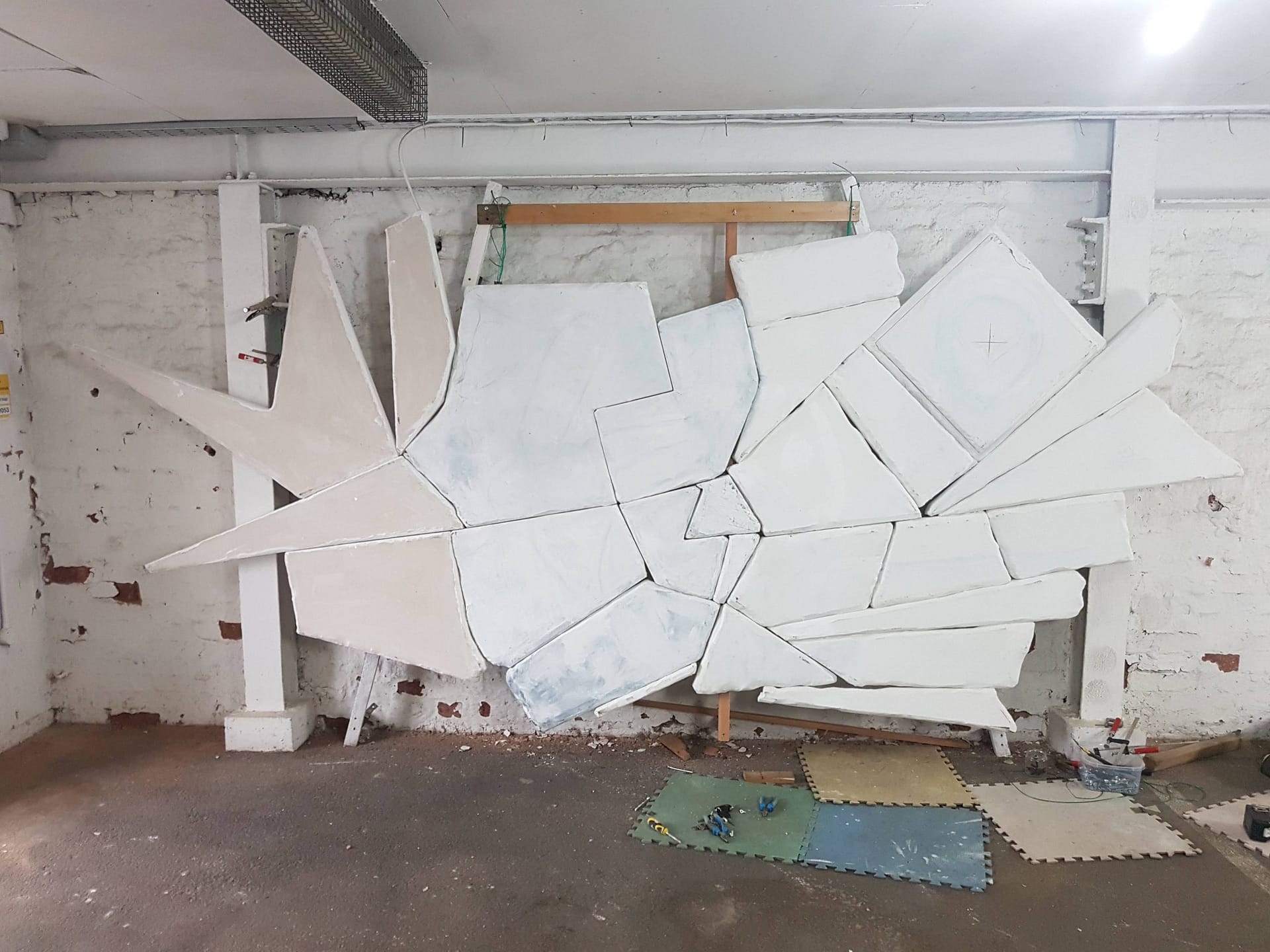
The first experiments replaced the single canvas with triangles, carved stone-shaped frames and modular stretchers. The process photographs show the support being invented before the image is painted.
Painting Becomes Architecture
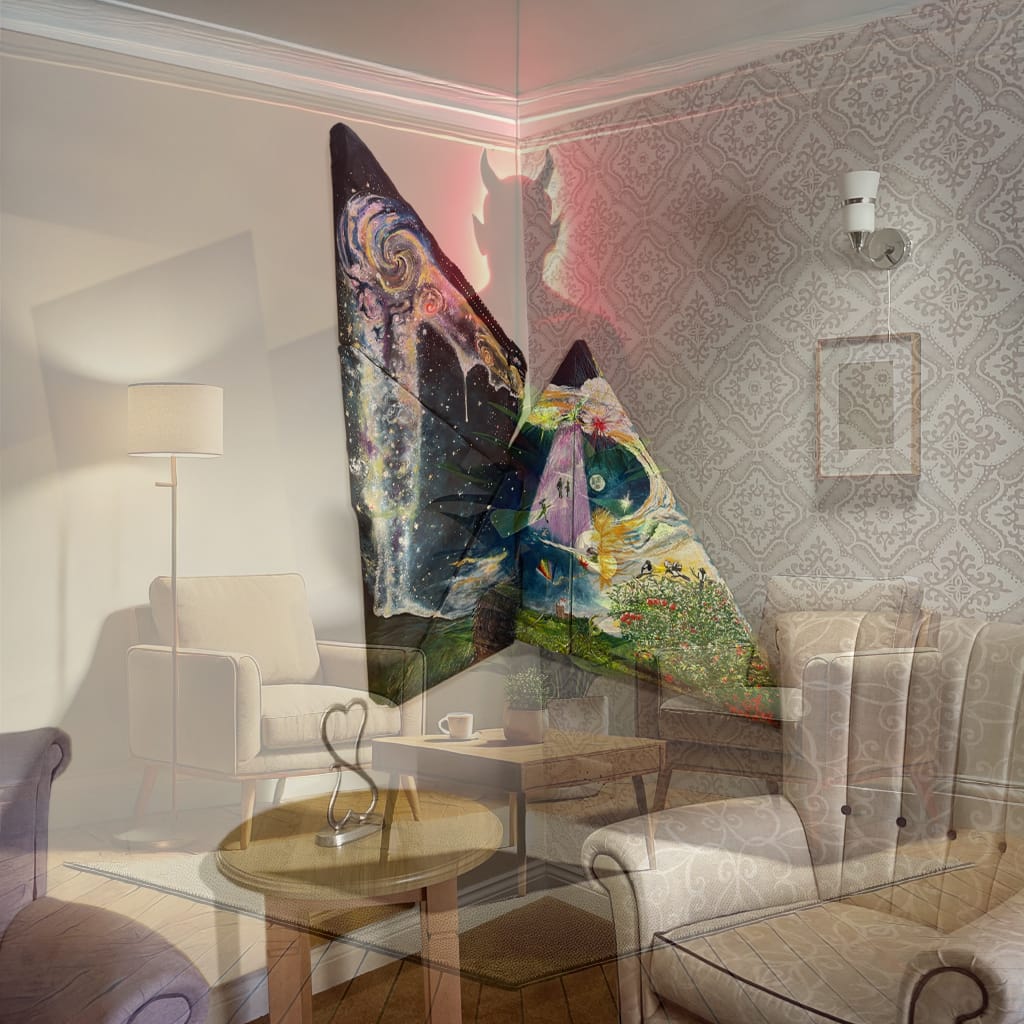
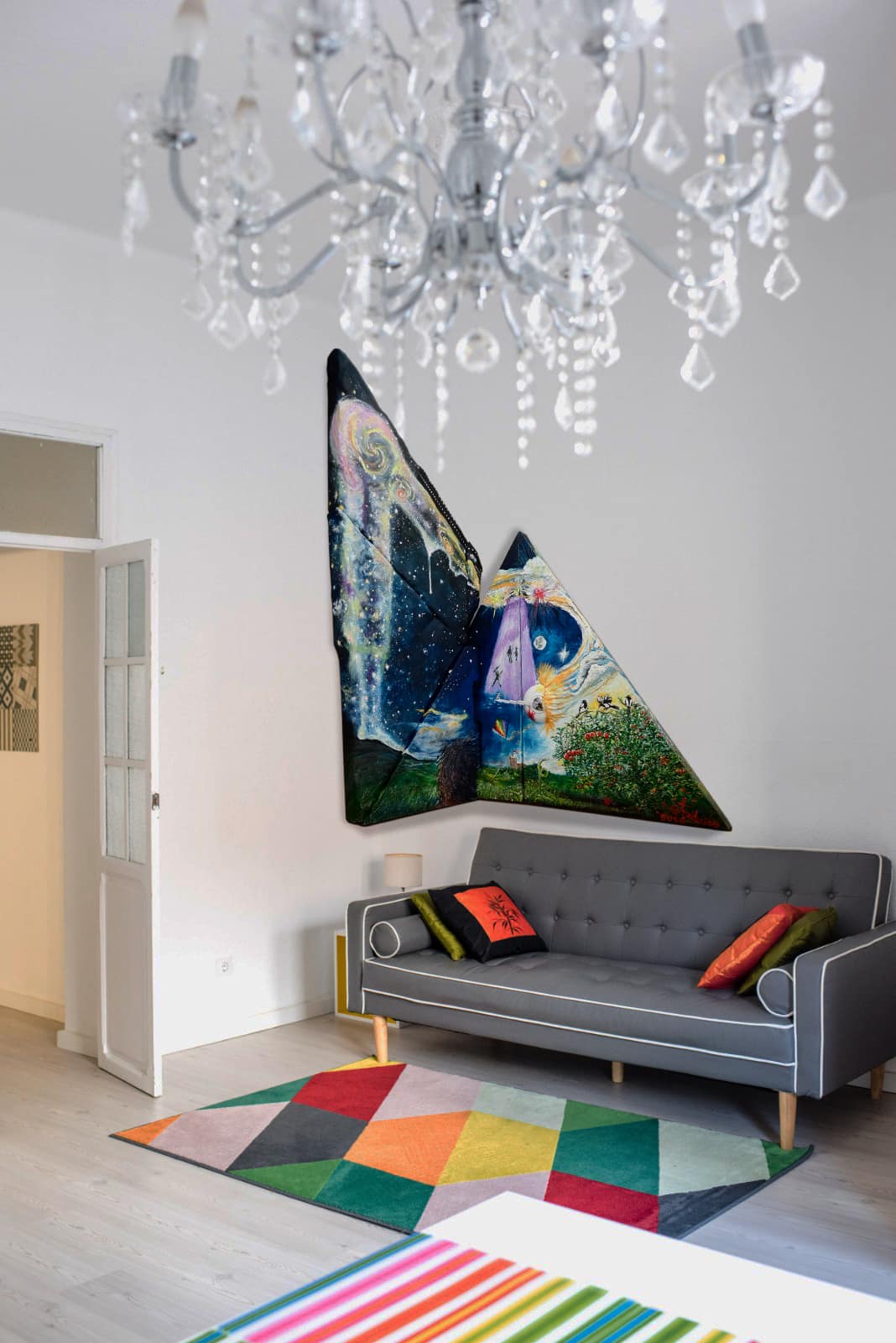
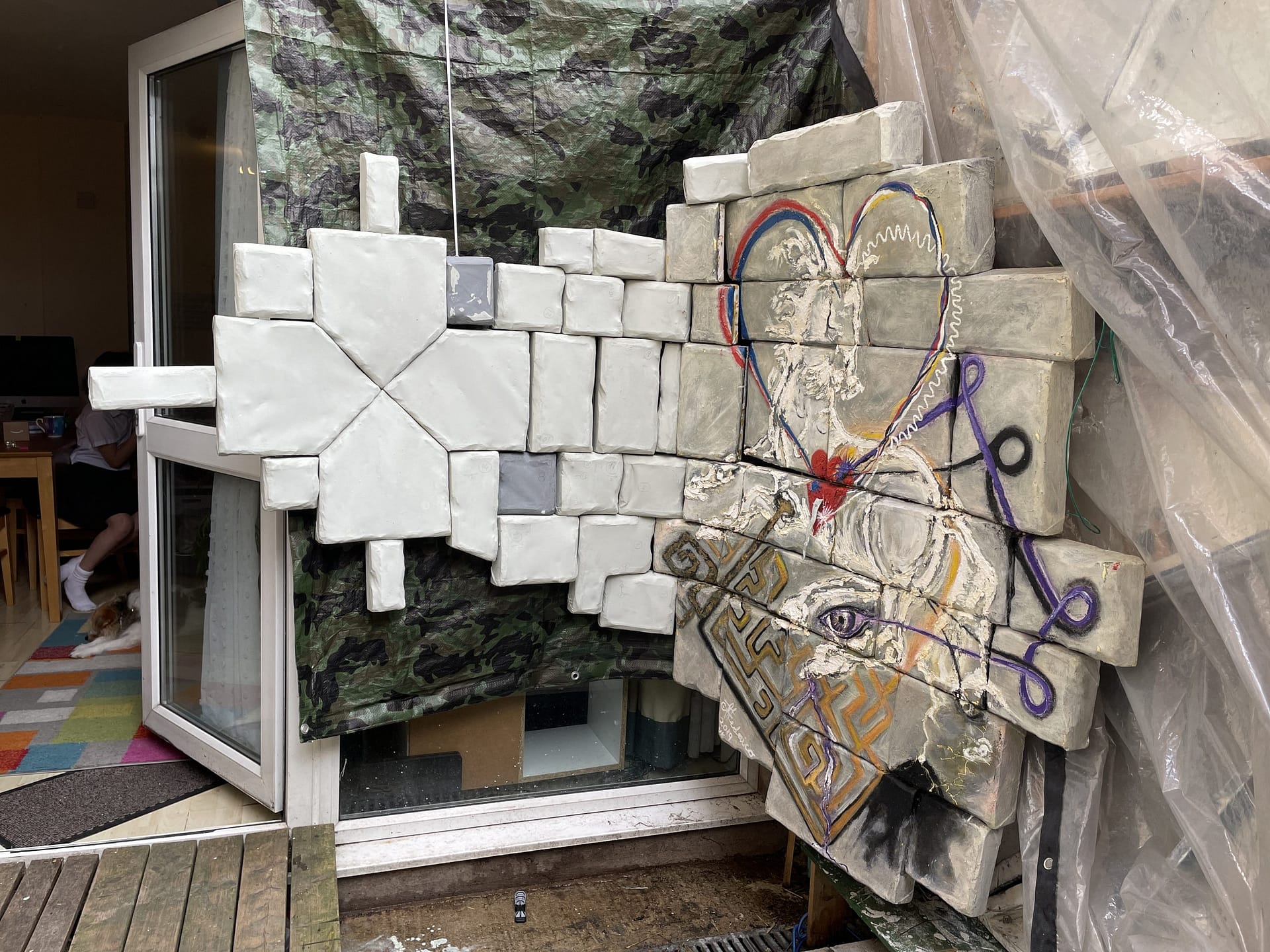
Once articulated, the painting no longer needs a flat wall. It can bend across an interior corner, softening the 90° angle it covers and turning the corner itself into part of the work.
The Works
- Rosa britannica
- Twin Particles
- Poachers’ Abduction Starts at Ten
- Thriving Society
- Balancing the 666
- Pizza Planet
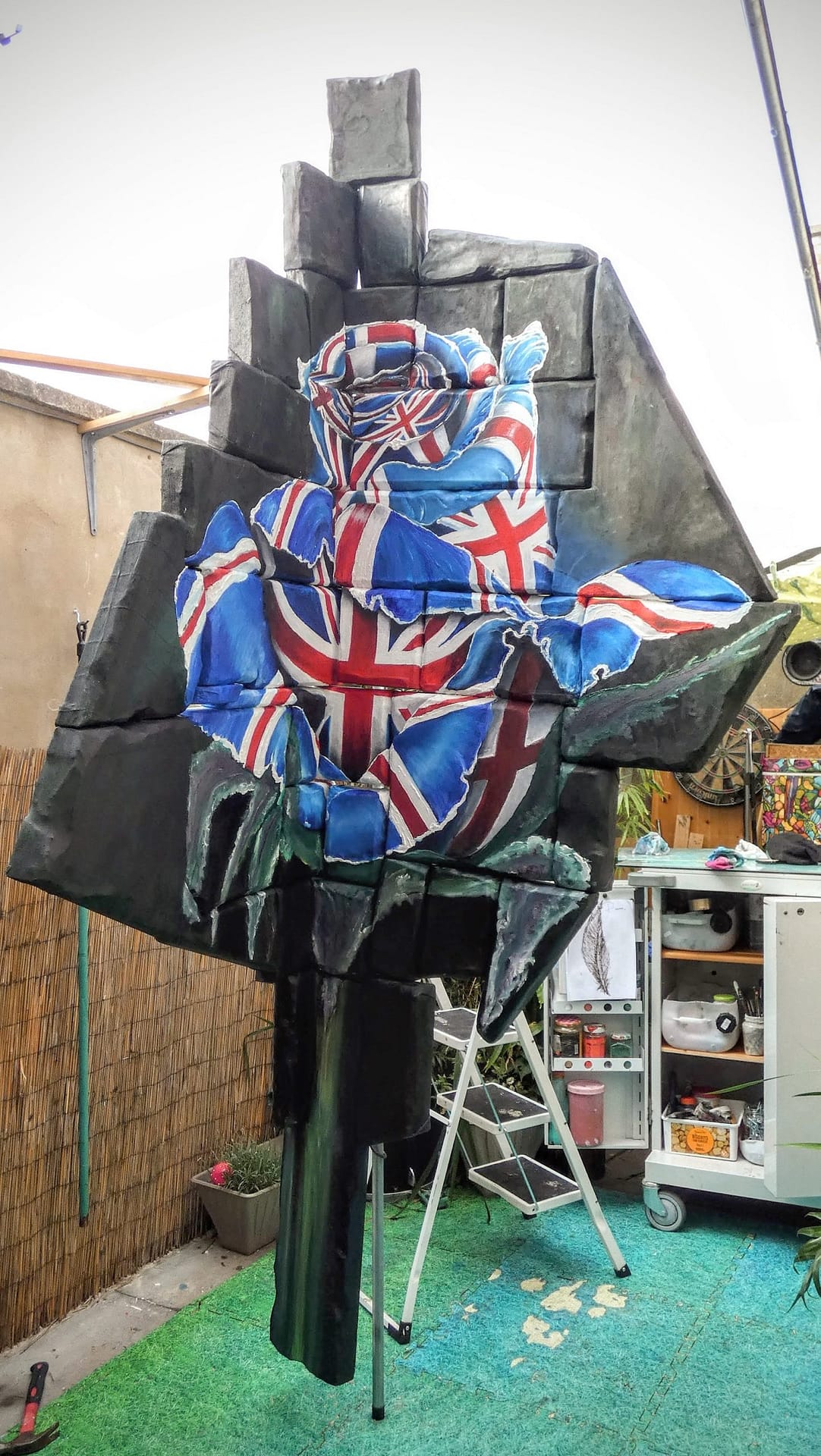
Rosa britannica
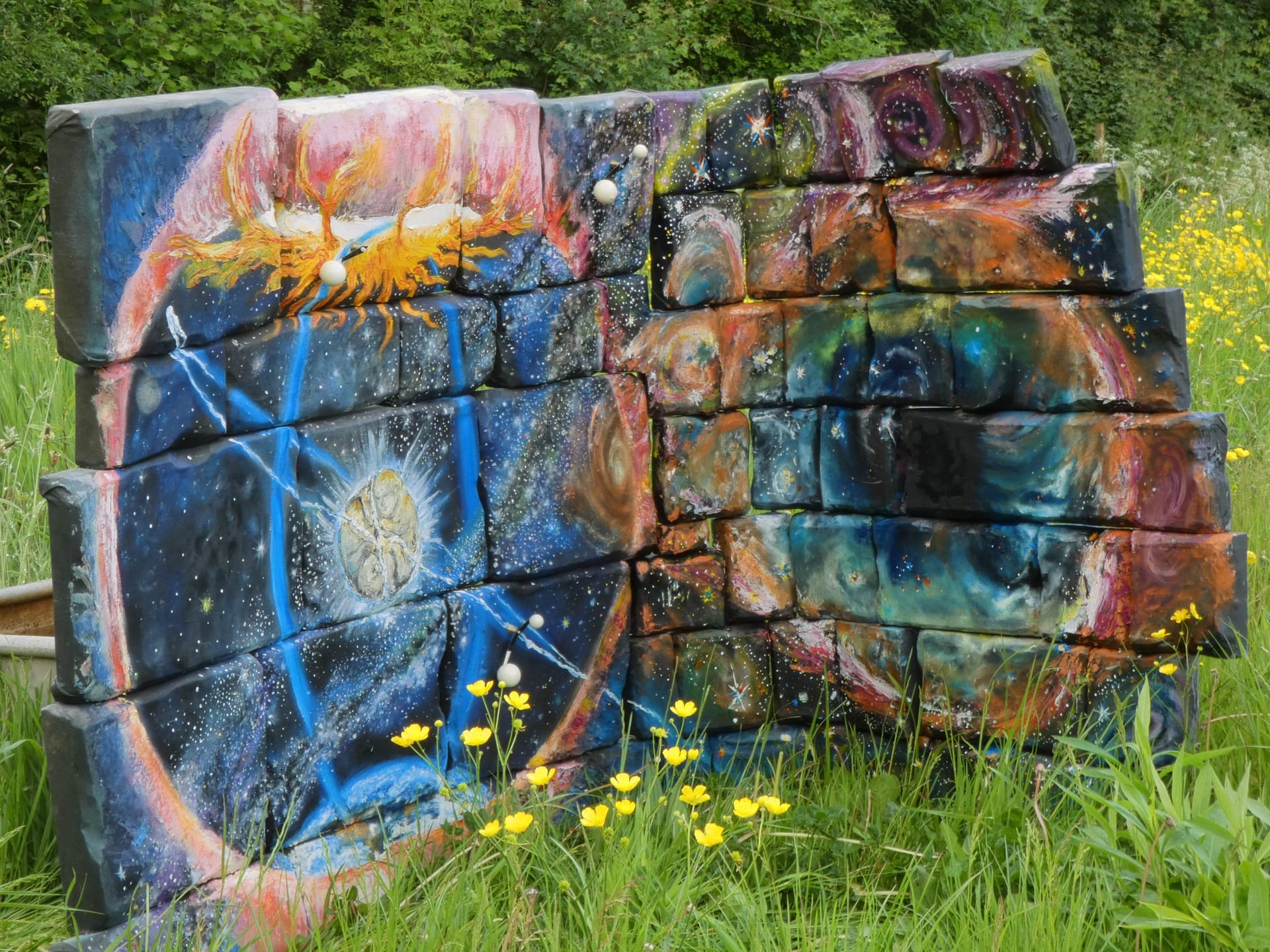
Pigments, oils and beeswax on 39 canvas stretchers fixed with screws.
Flexible: can be displayed on flat, rounded or angled walls.
270 × 190 × 8 cm (open, flat).
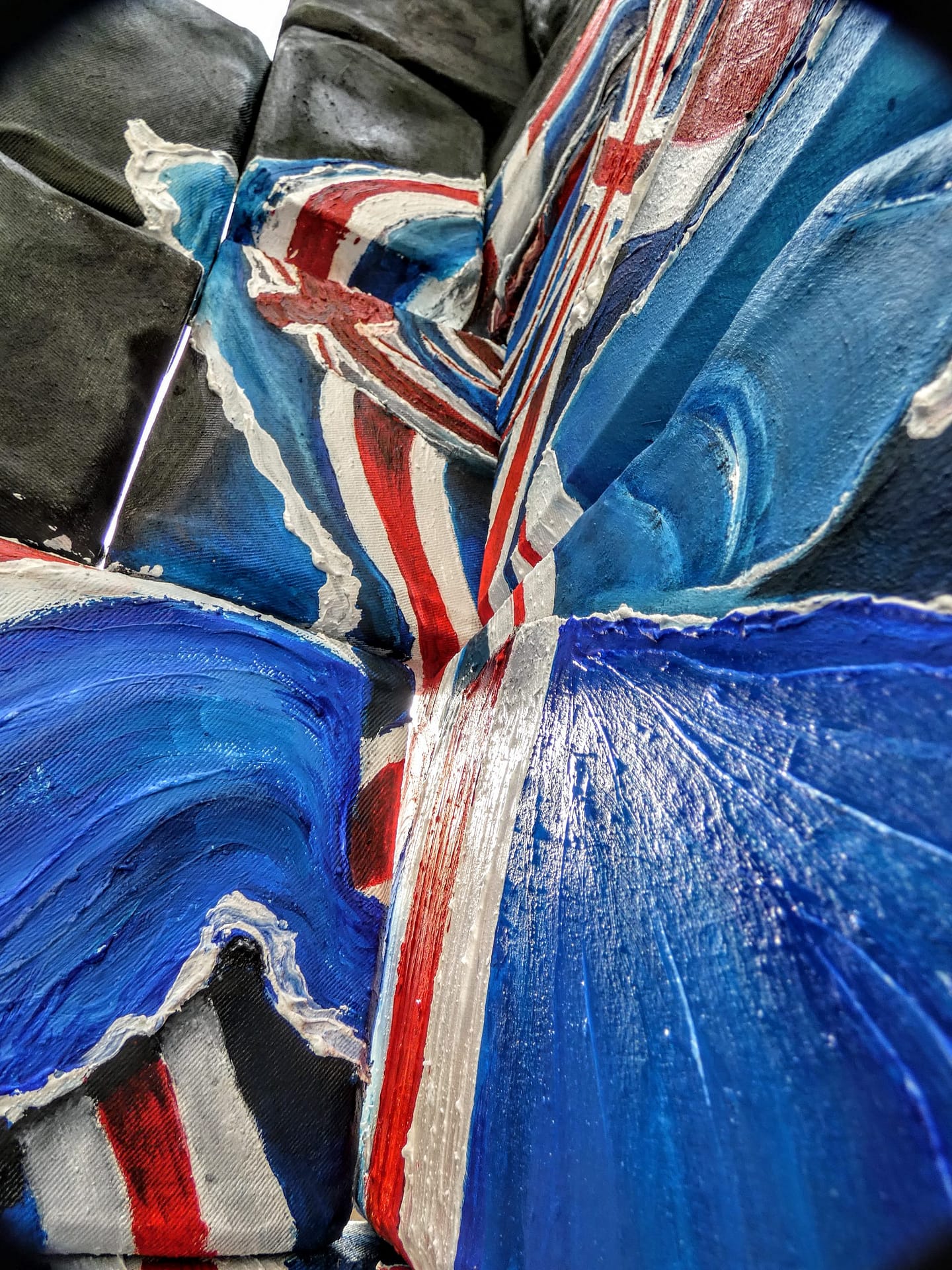
A rose whose petals are stamped with the British flag, linked to the infinite Universe. The idea came from a visit to Birmingham Museum, where a circular room of landscape paintings revealed the contrast between rectangular canvases and the fluid nature of the universe. Built from thirty-nine separate stretchers, the painting can open, fold and adapt to the wall it occupies.
Artist’s statement
Straight lines end in nooks and corners; paradoxically, at the time of the Industrial Revolution, corners were famous for straightening out the “twisted” people of their time. The Birmingham museum highly appreciates the Newtonian model that measures and predicts everything. It was the nostalgic inspiration to make the “Rosa britannica” with petals stamped with the British flag, linked to the infinite Universe.
It uses pigments, oils and beeswax on thirty-nine canvas stretchers fixed with screws, making it flexible and able to be displayed on flat, rounded or angled walls. We are so immersed in the paradigm of square shapes that this strategy is a subtle way of rethinking something closer to the quantum world. Uniting many squares and other geometric shapes could explain how to get out of the rigidity of the square frame, agreeing with the curved “forces of nature” without offering space to the famous Lucifer of details.
Advances in science also bring new emotions. And that human transcendence in the search for knowledge must be the true leitmotif of art.
Twin Particles
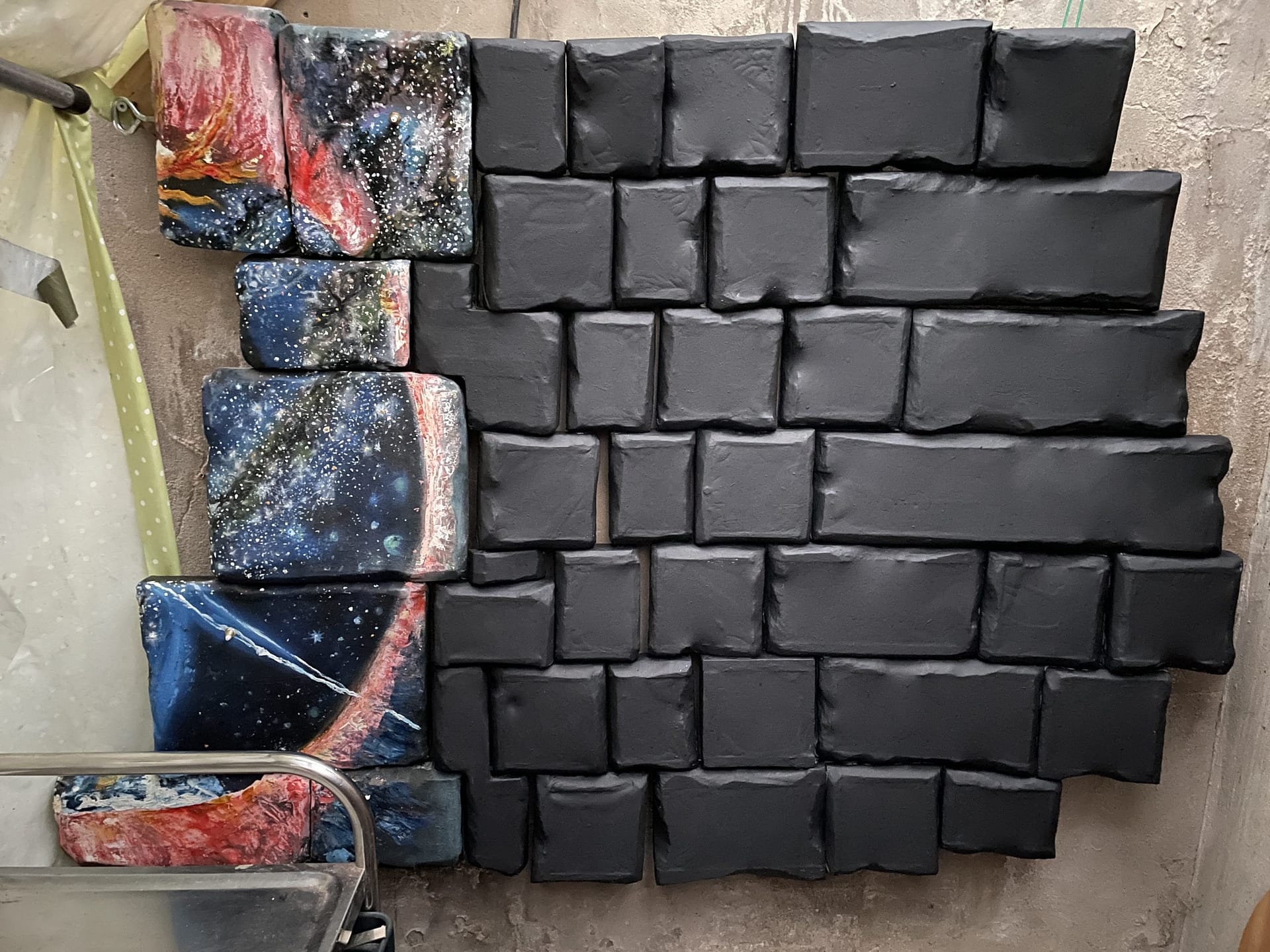
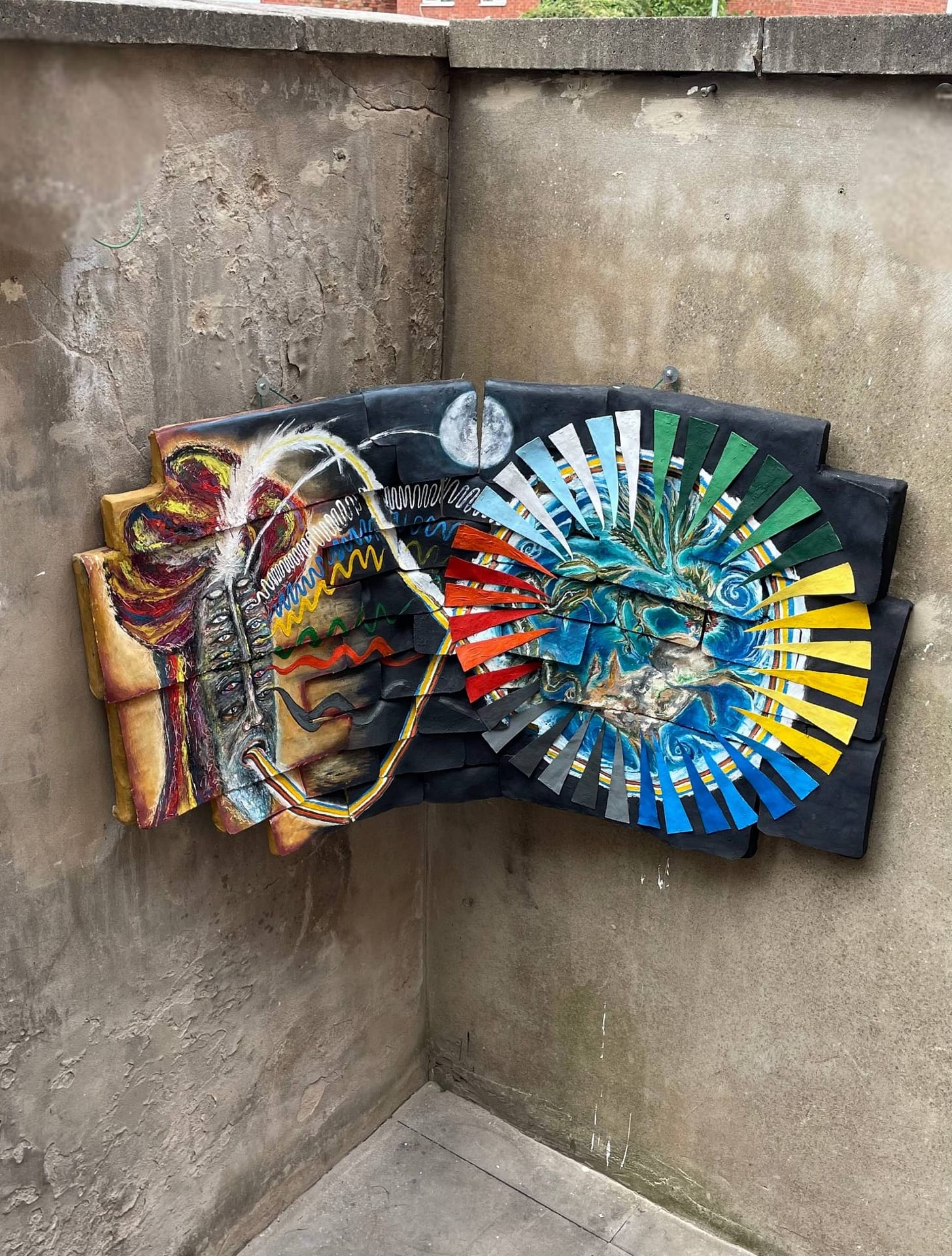
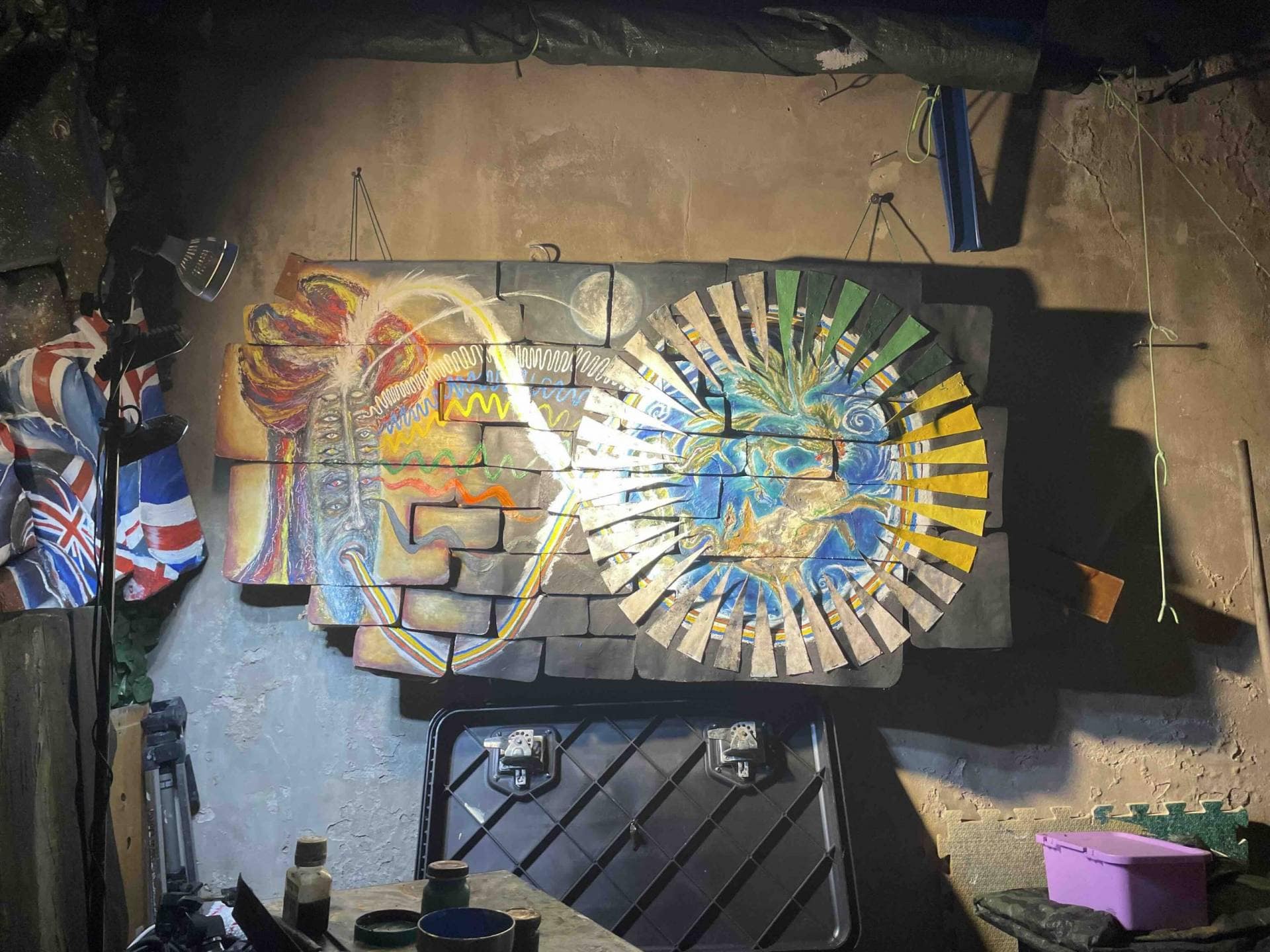
Modular “flexi” canvases, primed in black and joined together.
Installed flat or bending across an interior corner.
Oil on canvas. 110 × 212 × 8 cm (open, flat).
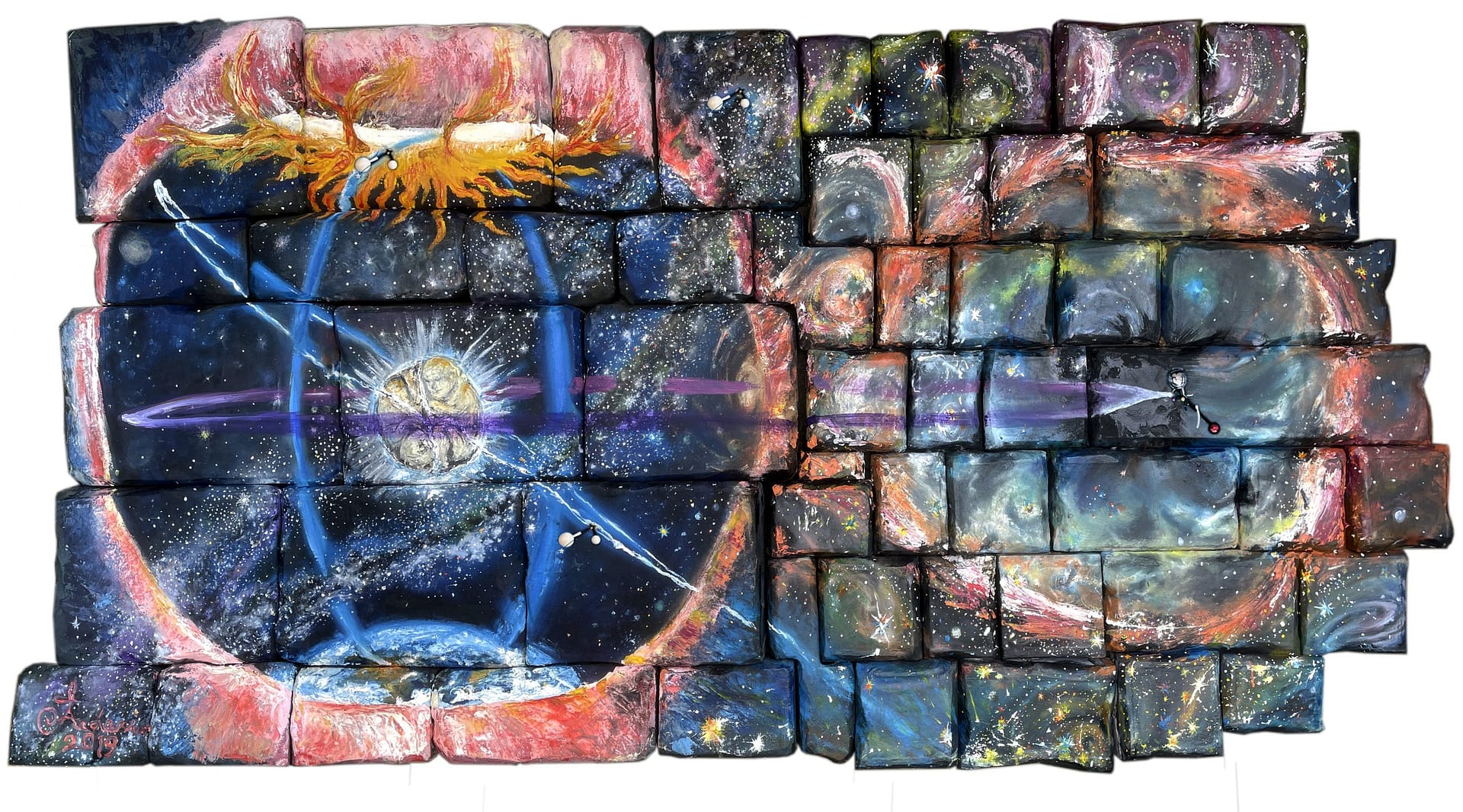
United “stones” curved like the Universe: a nucleus of twin particles connected at once in the Sun, the Earth and the Infinite, with a retrograde clock. The narrative draws on the childhood of Krishna, in whose mouth his mother Yaśodā glimpsed the whole universe. Physically, this is the clearest demonstration of the Curvist method — the painting was extended canvas by canvas until it could wrap around a corner.
Artist’s statement
In the golden age of ancient Greece, the Periclean era, the Western ways of reasoning about life created the most abstract and adaptable complex of ideas ever used to understand other life systems.
During the Victorian era, the English government adopted this as an educational model to break the square schemes of different societies they needed to understand in order to conquer. They intelligently molded their learning approach beyond the rigidity of their historical moment, enabling their troops’ minds to adapt to other regions of the planet and successfully conquer them.
This Victorian strategy of translating their era into a timeless one serves as a powerful and adaptive lever to move the art world again, carrying us from sad, measurable shortcomings to the happy abundances of the infinite and unknown.
From this beautiful world with more emptiness than matter, where abundance exists because we co-create it before seeing and measuring it, I became entangled with these atomic twin particles that cannot be separated. This infinity resembles Krishna’s childhood, when at eight years old, he played with other children. When one of his brothers told his mother that Krishna was eating dirt, Yaśodā confronted him asking, “Is it true that you are eating dirt?” Lord Śrī Kṛṣṇa replied, “My dear mother, I have never eaten dirt. All My friends who complain about Me are liars. You can examine my mouth directly if you think they are telling the truth.” [SB 10.8.35]
Mother Yaśodā, by divine grace, could understand the absolute truth. Yet her supreme teacher, under the influence of the internal potency, Yoga-māyā, inspired her to become absorbed in intense maternal affection for her son. [SB 10.8.43] Immediately forgetting the illusion of Yoga-māyā that Kṛṣṇa had displayed the universal form within His mouth, mother Yaśodā took her son on her lap as before, feeling greater affection in her heart for her transcendental son. [SB 10.8.44]
This story of Krishna captured in my work reflects a nucleus of twin particles connected simultaneously in the Sun, the Earth, and in Infinity with a retrograde clock. I attempt to create united stones curved like the Universe — a propaganda for the beautiful world of quantum uncertainty — covering the unnatural corners of our chaotic architecture.
Poachers’ Abduction Starts at Ten
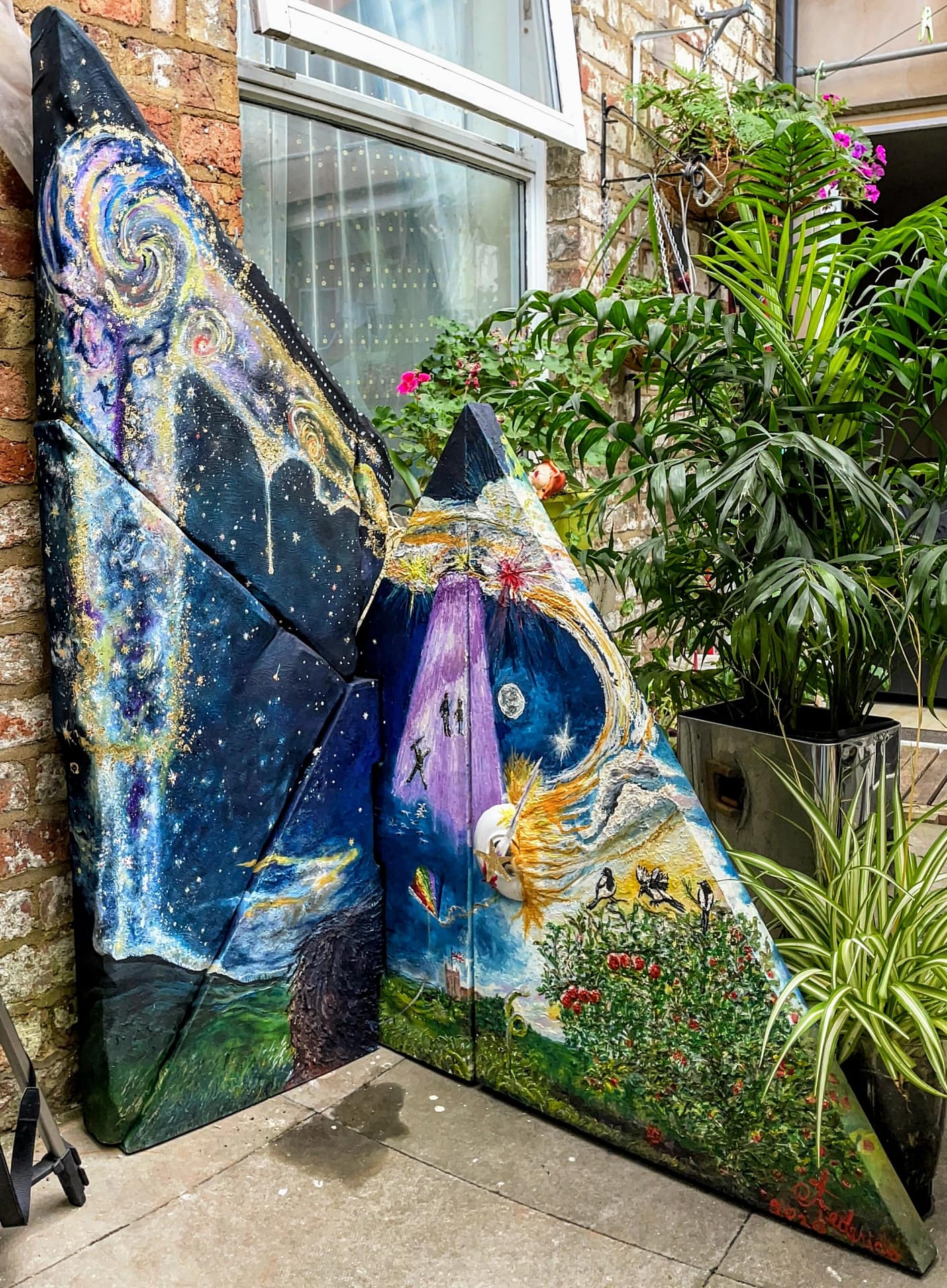
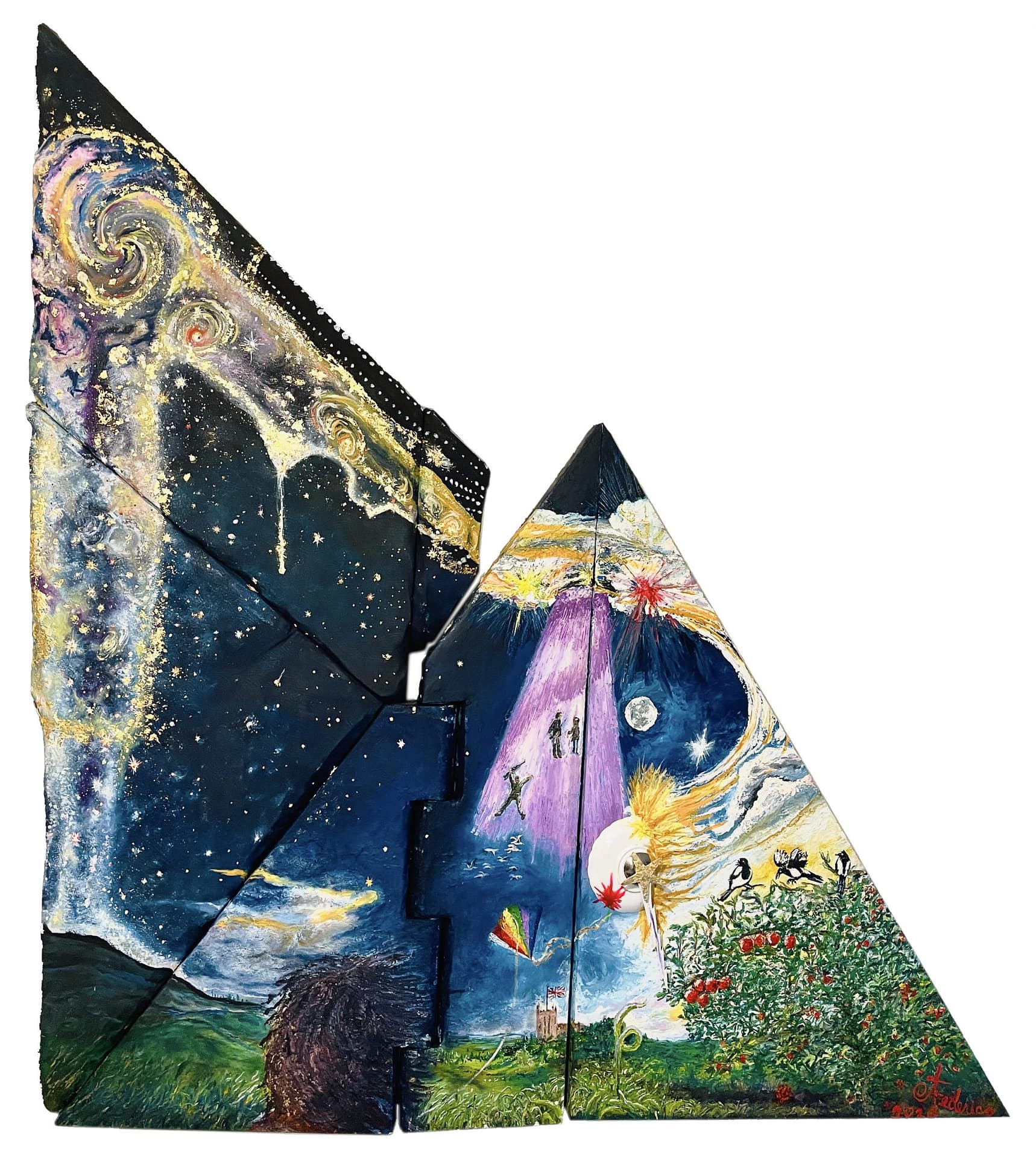
Began as a triangular diptych; triangular canvases joined with a hinge.
Oil pigments and beeswax. Installed flat or folded into an interior corner.
150 × 140 × 8 cm (open, flat).
Inspired by the green hills of the English Cotswolds — beautiful, yet, as Sir David Attenborough reminds us, among the most impoverished places on the planet for wildlife. The Milky Way, personified by the Egyptian goddess Nut, bends the straight lines and sends a flying-saucer clock through a golden portal: the poachers’ abduction starts at ten.
Artist’s statement
This painting began as a triangular diptych inspired by the beautiful landscapes of the controversial English Cotswold. Lovely, and rich with pleasant green hills, but as naturalist Sir David Attenborough sadly reminds us, speaking of wildlife, it is among the most impoverished places on the planet. We have plenty of fingers if we want to count species while walking through these beautiful landscapes. At this time, few animals are left alive, and there are still hunters who boast of being so.
Then I wanted to create an alien abduction to clear up the mess. And the clock symbol says that: THE POACHERS’ ABDUCTION STARTS AT 10. Now it’s up to the Milky Way, represented by the Egyptian goddess Nut, to bend the straight lines. She was the one who sent the flying saucer clock, through that golden quantum portal, to accelerate the change of our bad habits of agriculture in the open field with little respect for animal life. Real signs of a rounder future for everyone.
Thriving Society
Modular canvases bolted together and bent.
Installed curving across an interior corner.
Oil on 53 canvases. 152 × 241 × 8 cm (open, flat).
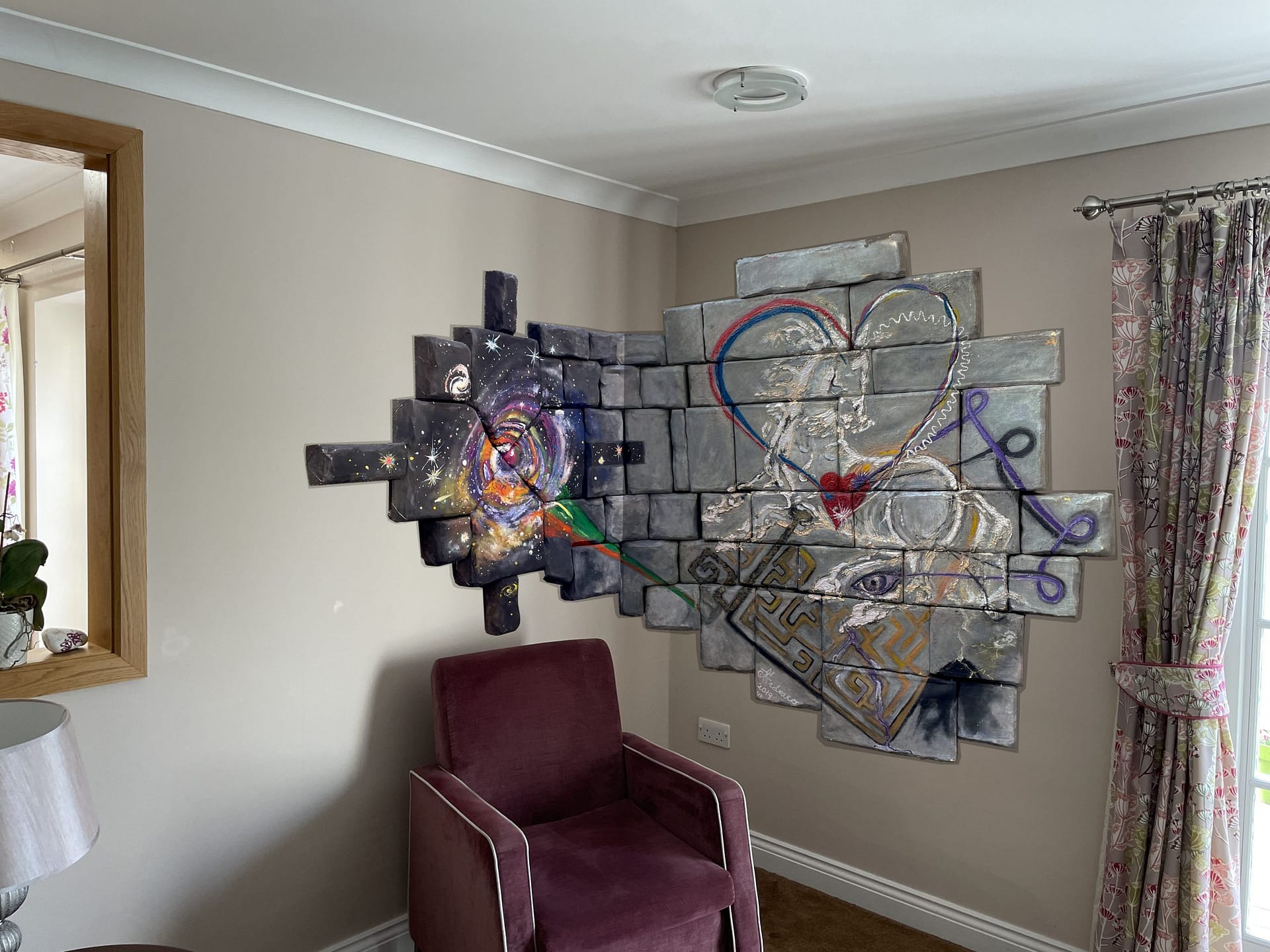
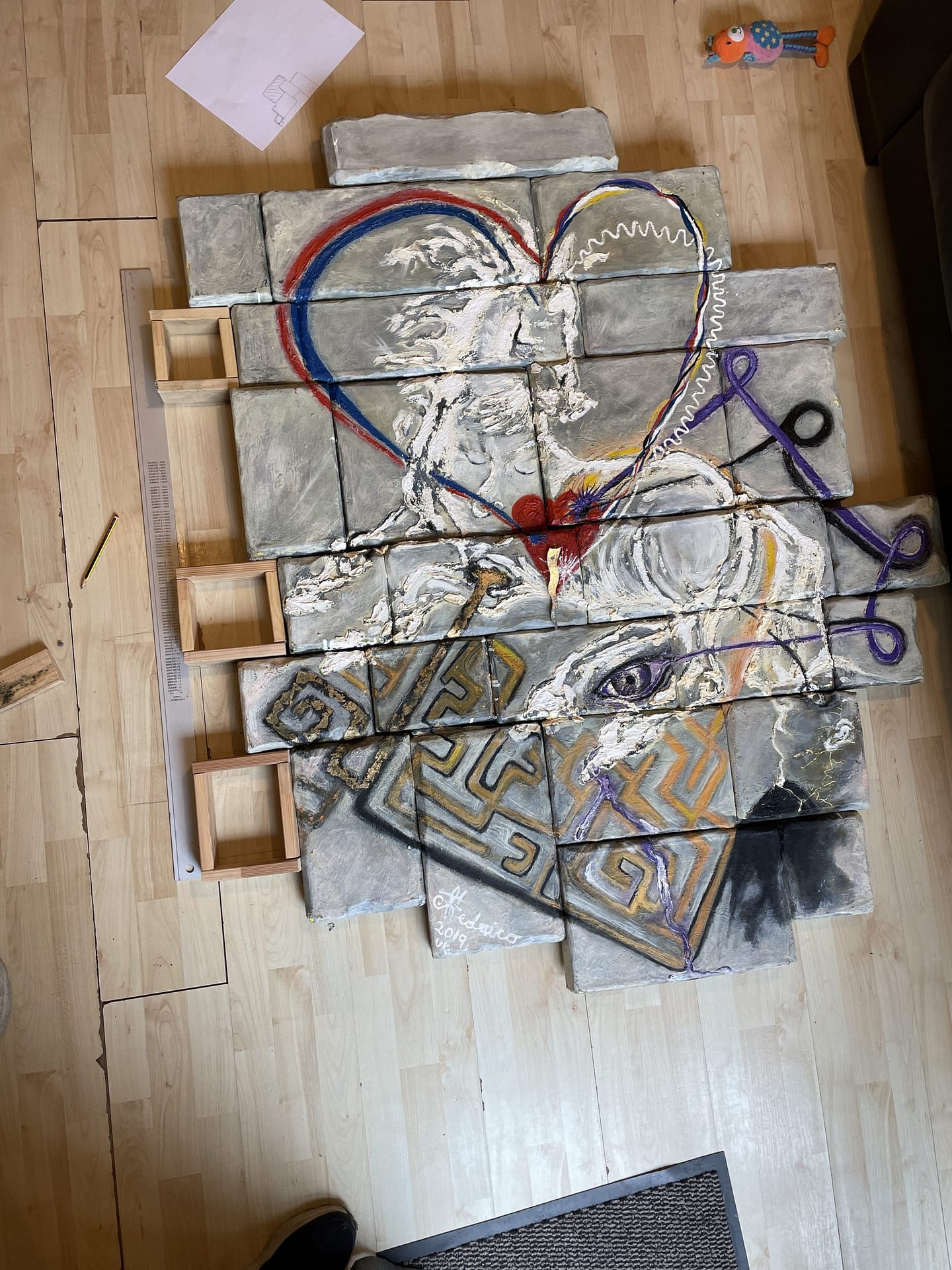
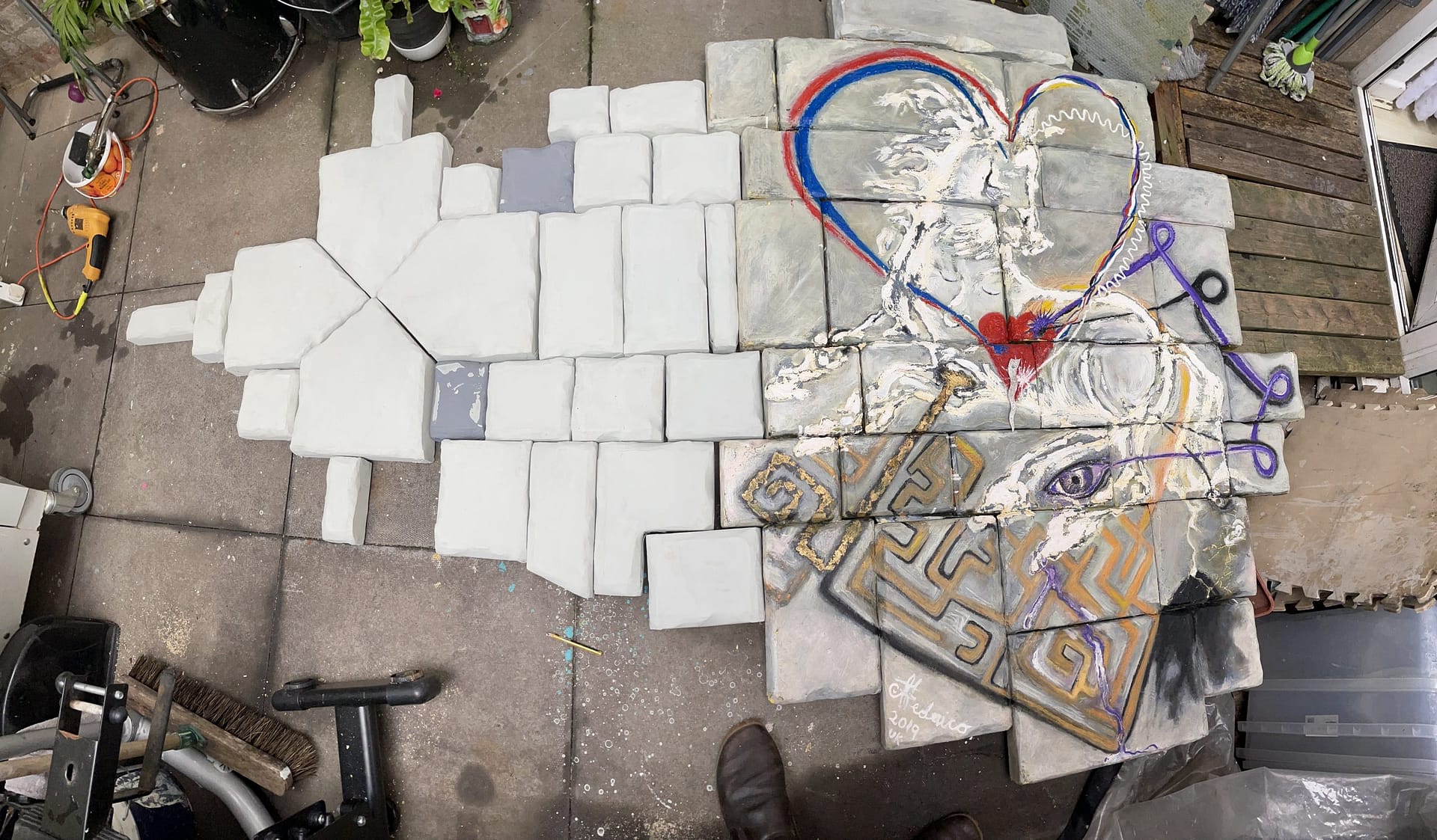
A horse — first seen as graffiti on a stone wall — symbolises society and seven ways of learning through life, connected to the dust of the stars. A clock with silver hands marks the time we spend prospering together; a red heart records our experiences. The first version was flat; the artist added canvases, bolted them together and bent the painting into the corner.
Artist’s statement
Horses symbolise society: the graffiti of one painted on a stone wall, as a solid statement for seven different ways of learning over time in our community life. In life, you must be curious to understand your growth process. Humans transcend by going through seven different essential life experiences. Societies in constant evolution are made and always connected to the dust of the stars; the clock with silver hands represents the precious time we consume living our lives prospering in society. The red heart symbolises our soul, where we record experiences as time passes.
- In the horse’s tail, a black tie to human passions: sex and lust.
- At the bottom of the horse, the black eye represents people who learn through painful lives.
- On the luminous chest of the horse, the face of people trapped in the labyrinth of gold, seeking to understand power. When death comes to them, they take to their hearts only what they have learned, symbolised by a yellow line.
- On top of the horse are those who live and love but are not expressive of that love. When these lovers die, they carry their deep experiences from their hearts in a blue line and rest in the All.
- At the head of the horse are those who love and know how to express that love, connected in red to Everything.
- Above, those who see God in all things connect with the purity of blank thought.
- And finally, the enlightened in this society. Thanks to their inner vision, they come to understand and realise God in themselves, connecting all the lines of different colours of learning into a single symbol of love and peace in the heart.
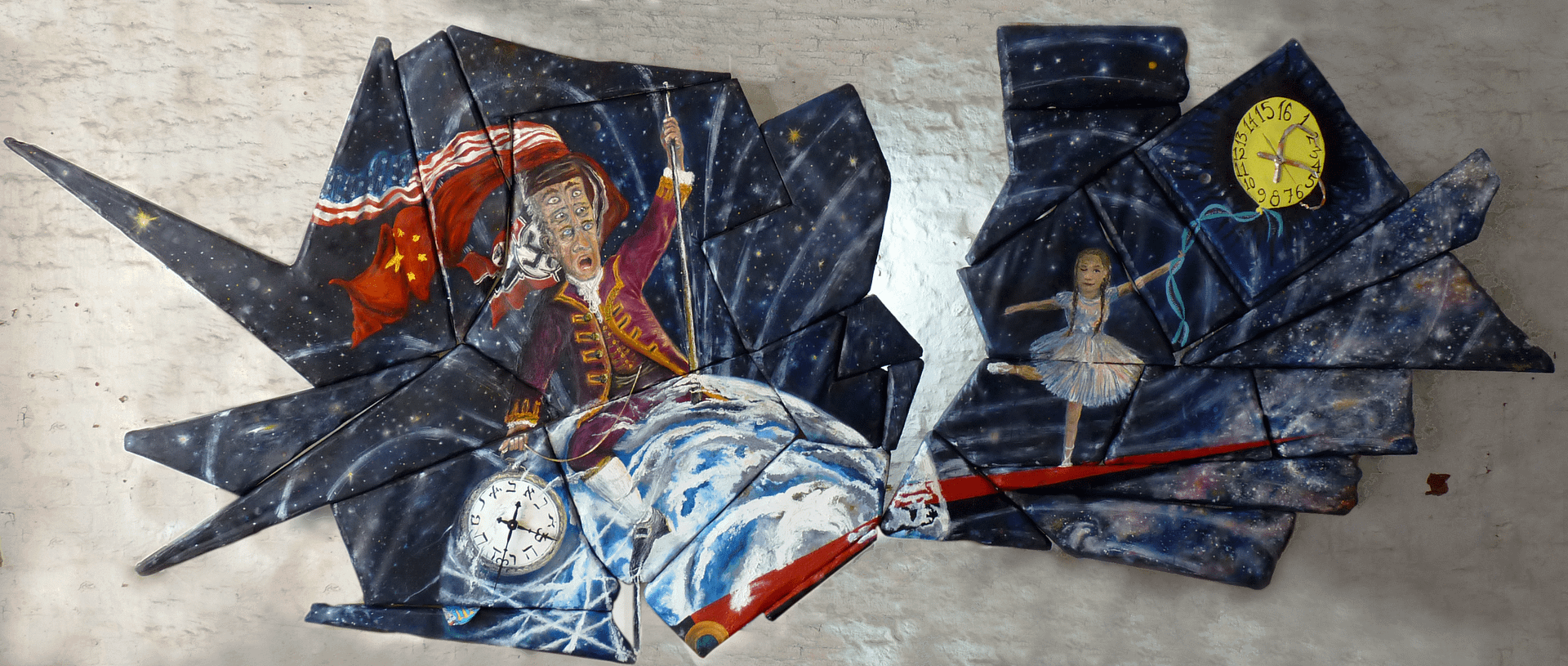
Balancing the 666 and the Seven Heavens
Stone-shaped canvas frames; includes a clock calibrated to a 16-hour day.
A fusion of two earlier paintings: Balancing the 666 (Venezuela, 2007) and The Seven Heavens of Ramtha (2006).
Oil on canvas. 200 × 415 × 8 cm (open, flat).
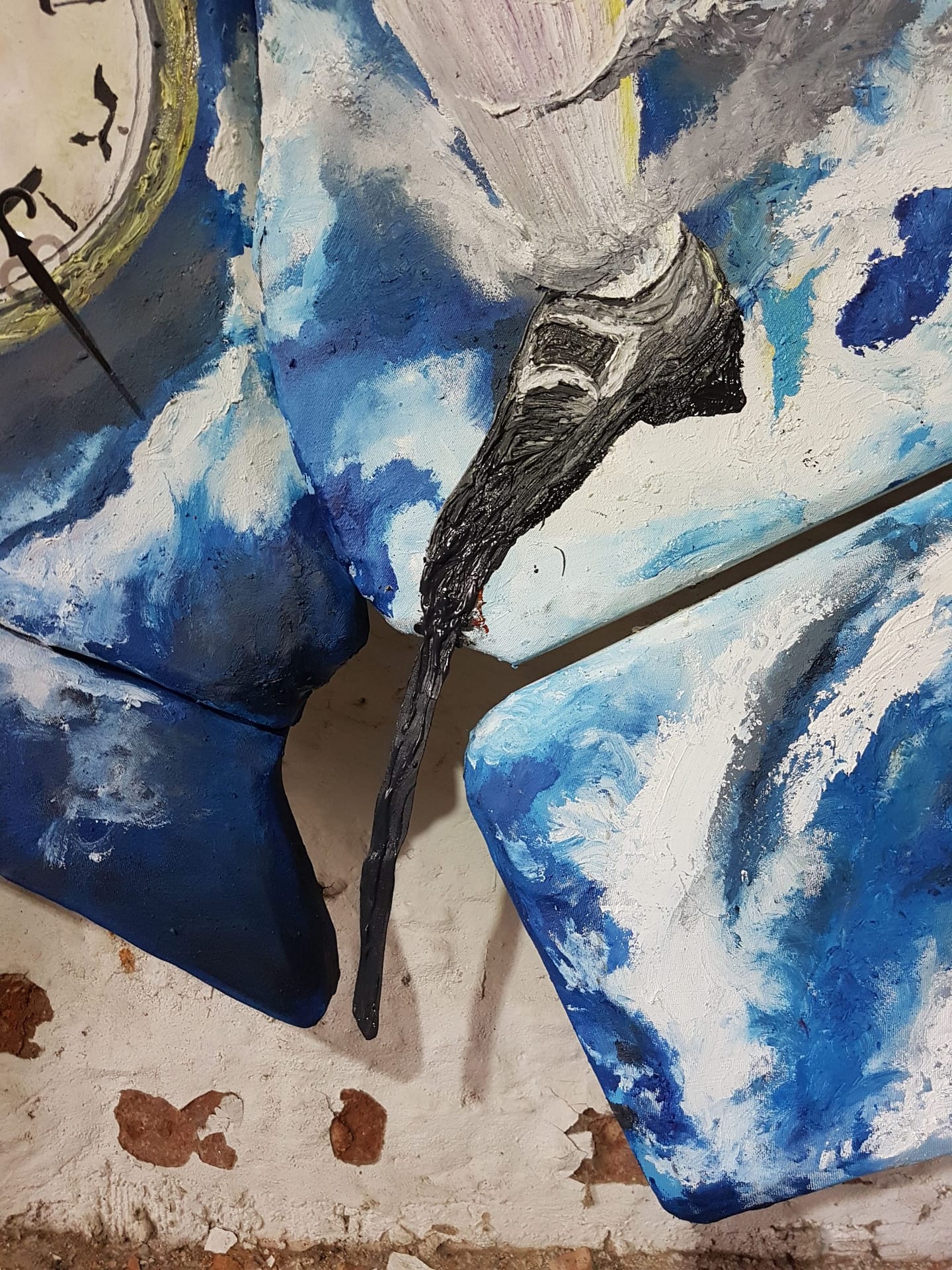
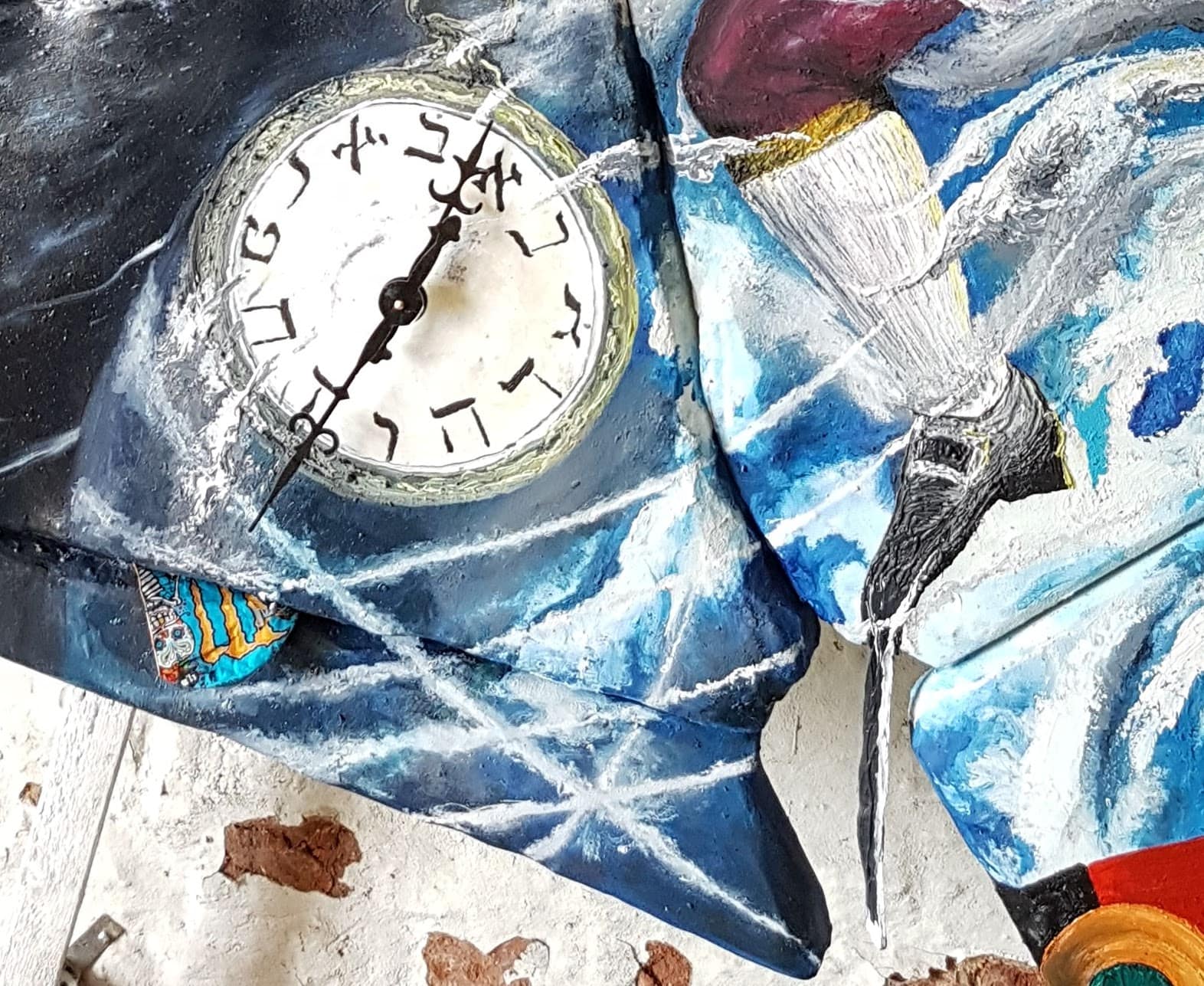
The three sixes stand for time, the 360° compass and gravity, after Lee Carroll’s Kryon. Seven pairs of eyes trace seven levels of consciousness from The White Book of Ramtha, the upper four veiled by patriotic flags. A figure in antiquated clothing clings to the Earth’s original axis beside a melting shoe and a distorted clock.
Artist’s statement
This artwork represents the essence of my artistic practice, a theoretical and aesthetic fusion of two of my earlier works: “Balancing the 666” (2007) and “The Seven Heavens of Ramtha” (2006).
The origin of “Balancing the 666”. Created in Venezuela in 2007, this painting draws inspiration from the book “Kryon, The End Times” by Lee Carroll. Kryon speaks of the significance of numbers as three-dimensional tools that carry energy. The three sixes (666), often misunderstood, represent time, rooted in Earth’s rotation and measured in our systems; the magnetic compass, the 360-degree system of navigation; and gravity, a fundamental force that binds us to Earth. This work reflects the evolving perception of time — how days seem to pass faster, symbolised by a mechanical clock calibrated to a 16-hour day instead of the traditional 24.
The Seven Heavens of Ramtha. This concept, inspired by “The White Book of Ramtha”, explores humanity’s spiritual ascension through seven levels of consciousness, each represented by overlapping pairs of eyes: survival and primal instincts; suffering and challenges; power through material wealth; feeling love without expressing it; feeling and expressing love freely; understanding that God exists in all things; and the highest level, “I am God”. In this painting, the upper four pairs of eyes are veiled by flags of patriotism, symbolising attachment to earthly constructs that hinder spiritual ascension.
The fusion. The figure in the painting, dressed in antiquated clothing, clings to the Earth’s original axis, symbolising resistance to change. His possessions — depicted as a melting shoe — represent the transient nature of material power. A distorted clock with oversized hands emphasises humanity’s distorted relationship with time, while an energy drink can floating in the ocean reflects the waste we leave behind. The viewer is invited to experience the painting on multiple levels, discovering their own truth within its symbolism — what I call the “Personalization of Truth”, a gateway to individual evolution.
Pizza Planet
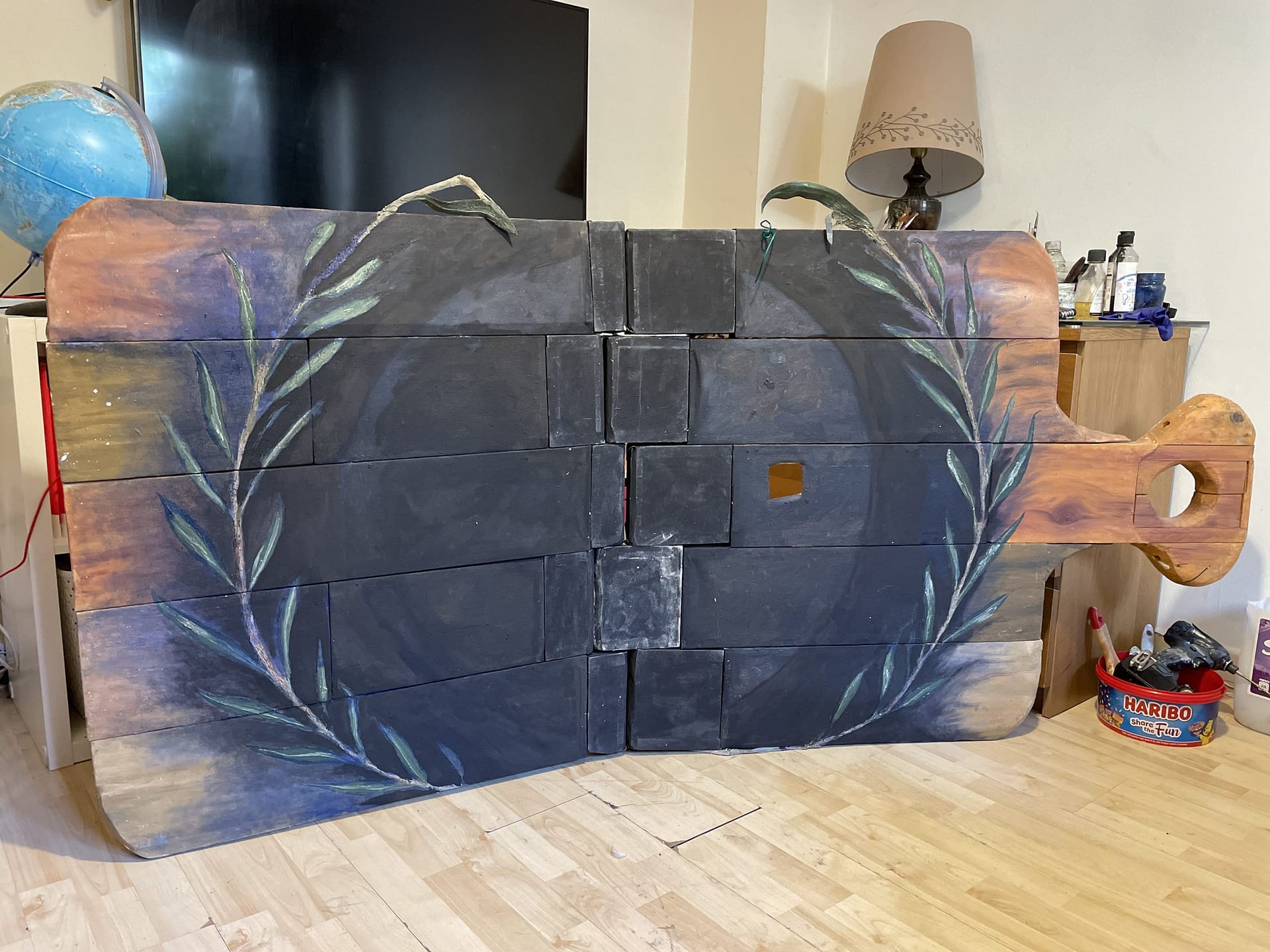
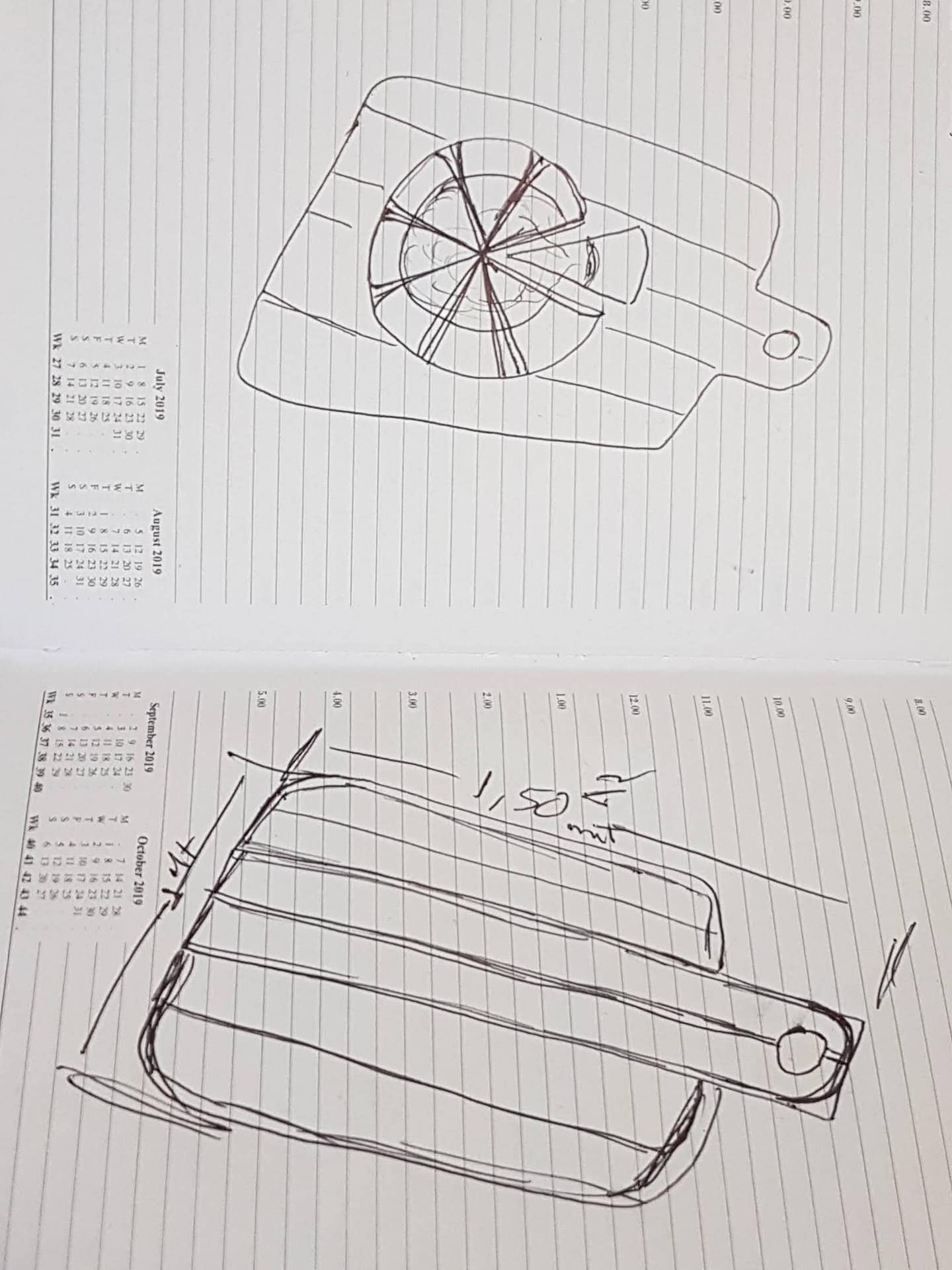
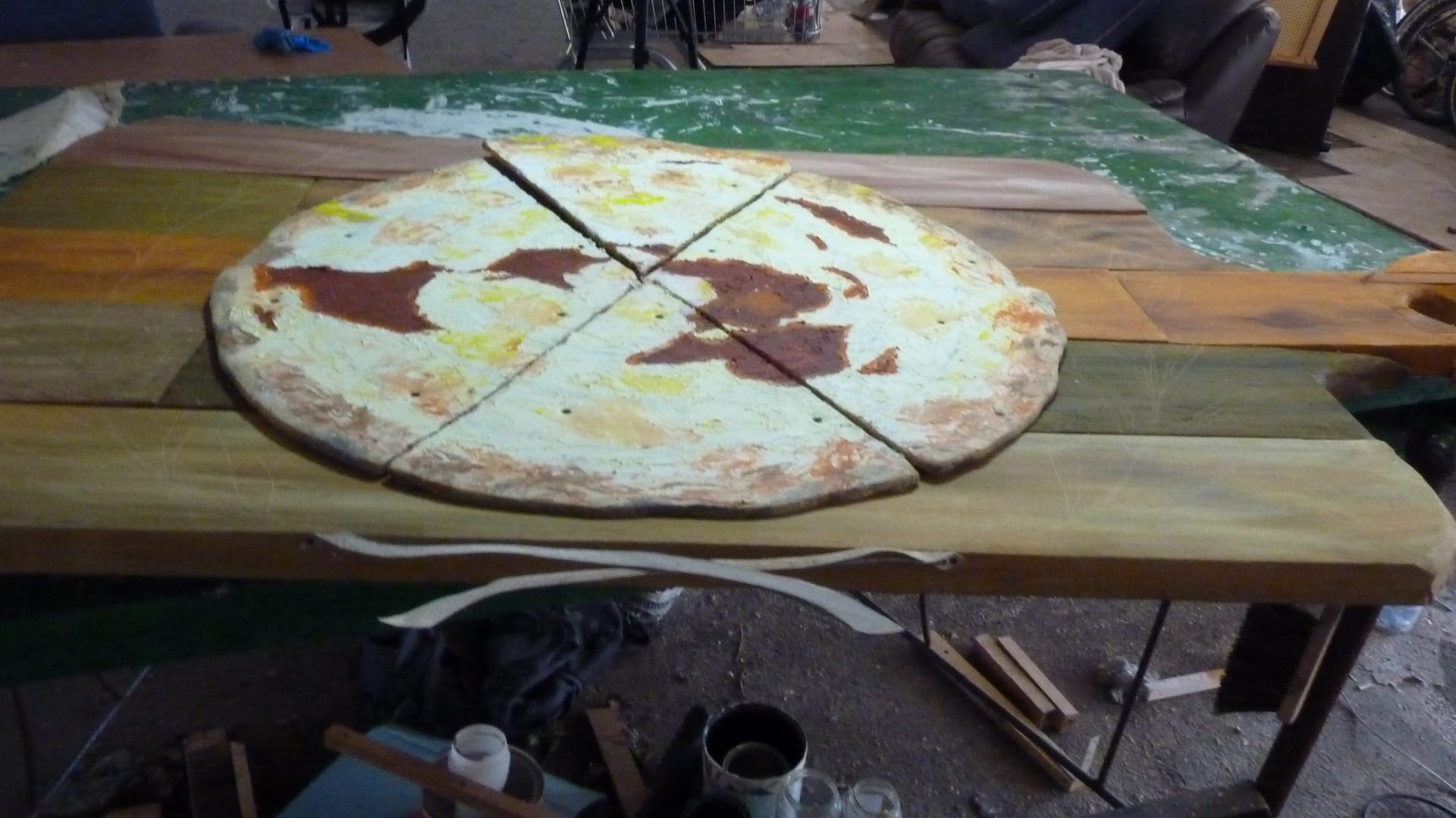
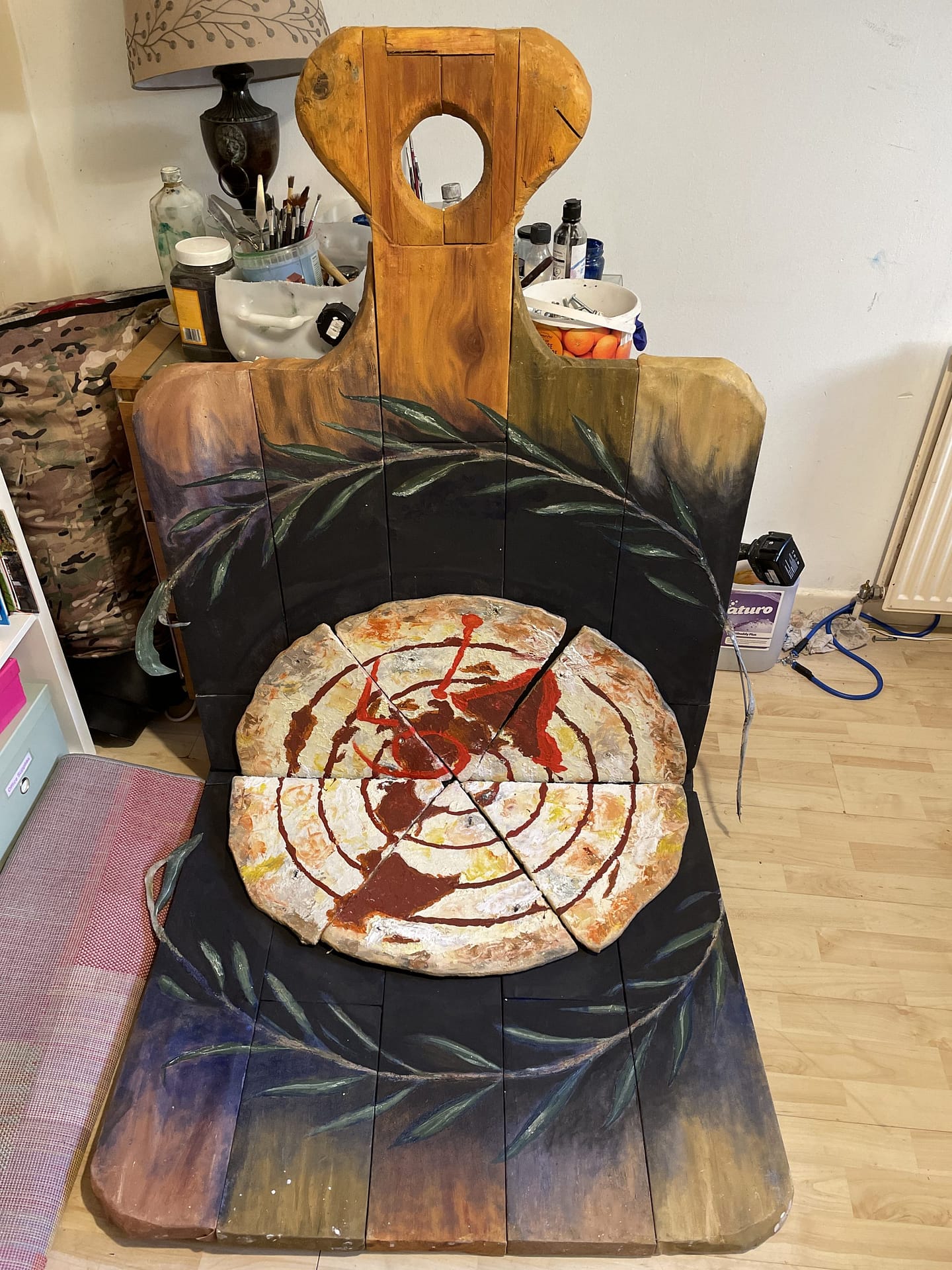
Built on a pizza serving board cut in half and hinged, with canvases and olive-branch wires.
Can be displayed flat or folded to cover a corner.
Oil on canvas. 120 × 205 × 8 cm (open, flat).
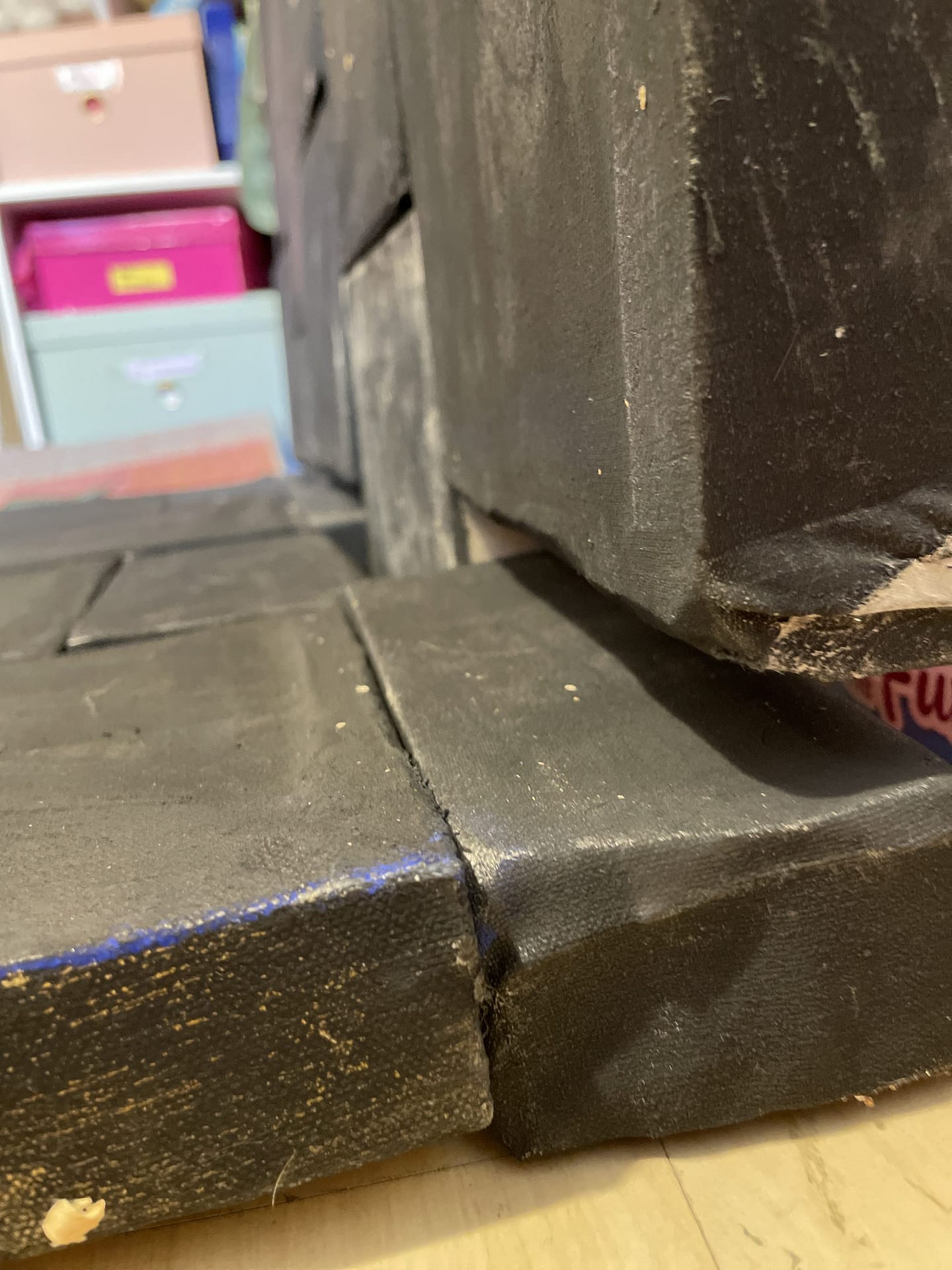
The Earth as the pizza we all love and are running out of. Olive branches — symbols of victory, power and peace since ancient Greece — crown a planet seasoned with “voodoo magic” and a retrograde basil clock. The serving board was cut in half so that the planet could fold and cover the corner.
Artist’s statement
In ancient Greece, where champions were crowned with olive branches, the olive tree symbolised the transfer of power. Kings and emperors were anointed with oil. Since Noah, when a dove brought an olive branch, it has meant peace. It embodies strength and vigour. Hercules’ club was an olive trunk, and Christ was arrested on the Mount of Olives.
The Romans spread that knowledge and later crowned the pizza with olive branches — that dish we all like, cut lengthwise and seasoned with sauce between parallels of continental salami. We all appreciate it, we all want to eat it, and we are running out of it. Whatever they say, the United Nations is a copy of that Roman culinary and cultural legacy that is our spaceship. I want to go back in time so that we don’t finish it.
I seasoned it with voodoo magic and inserted some numbers from the dark past in hot sauce, like a retrograde basil clock where China is. Later I enriched it by cutting the pizza serving board in half to cover the corners and give it a space touch, so we can see our Pizza Planet — to infinity and beyond!
Translated from the artist’s original Spanish text.
From Painting to Participation
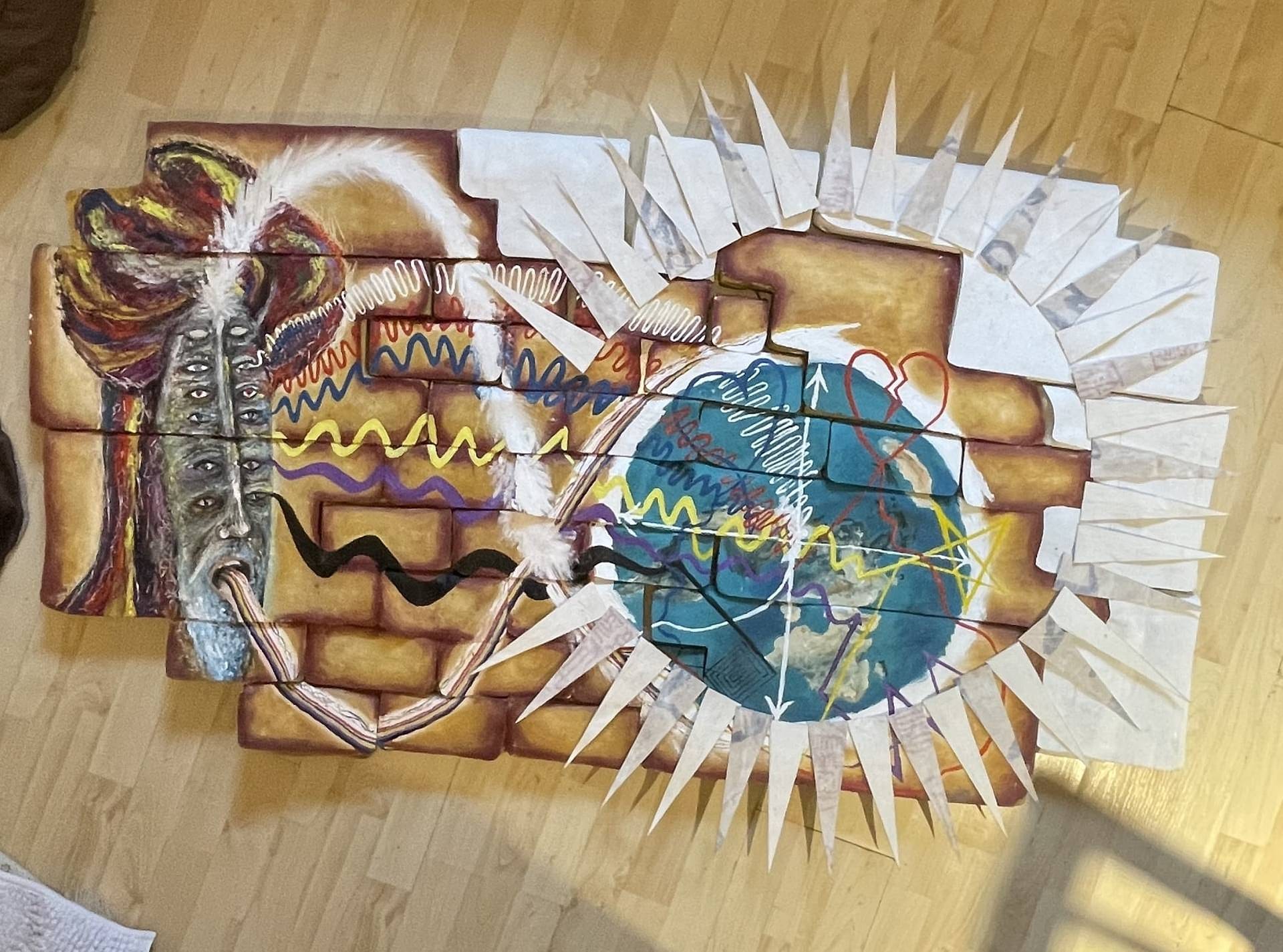
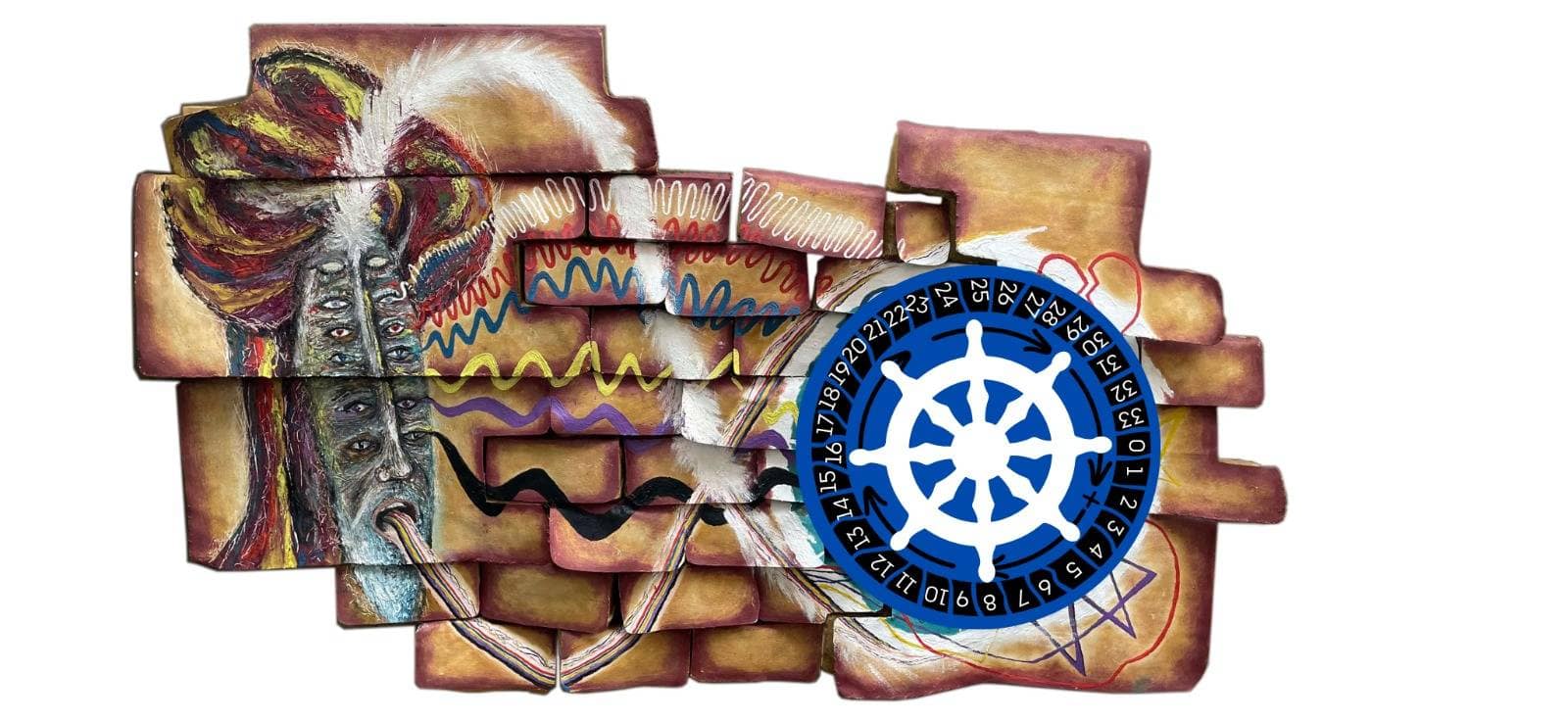
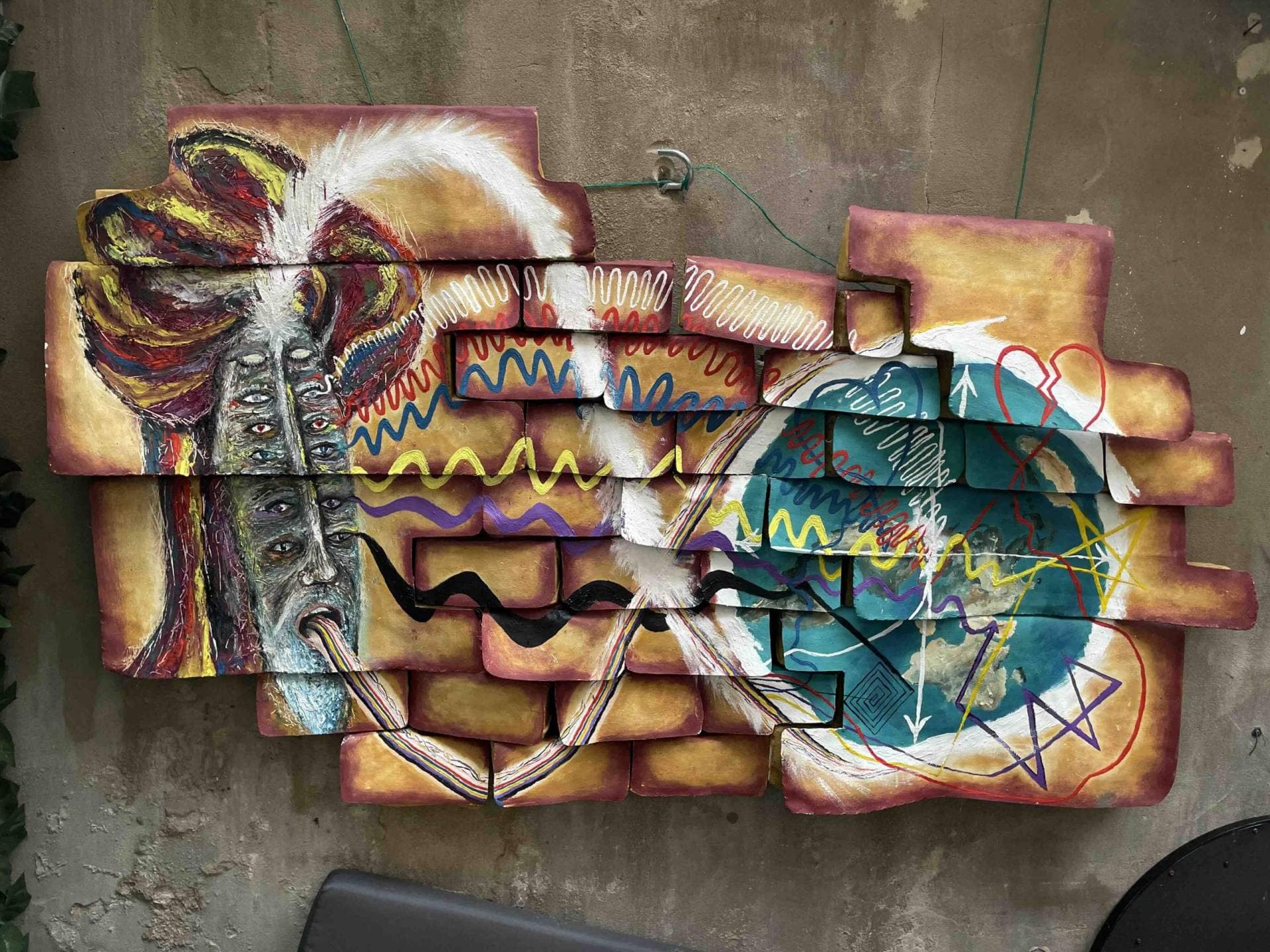
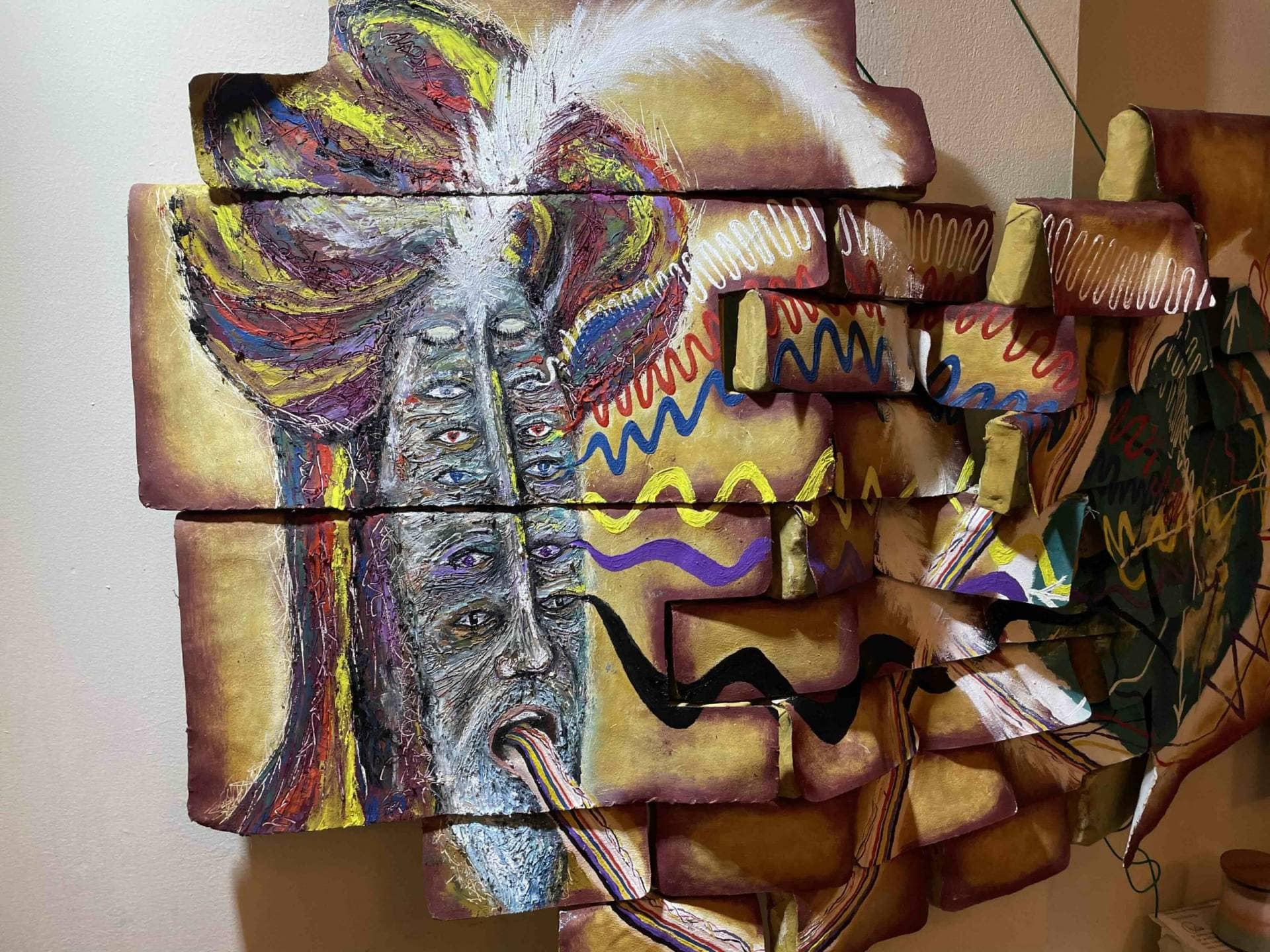
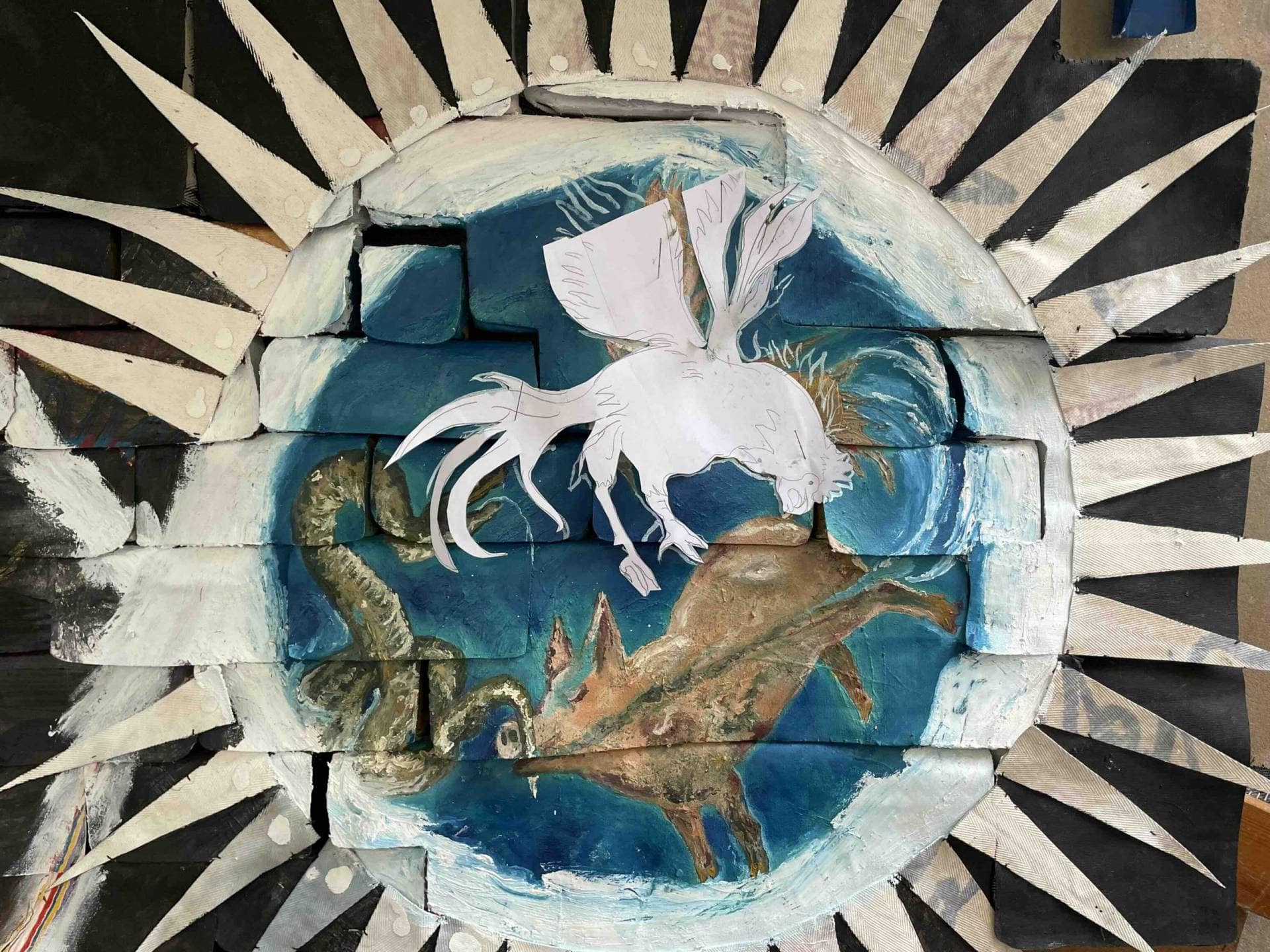
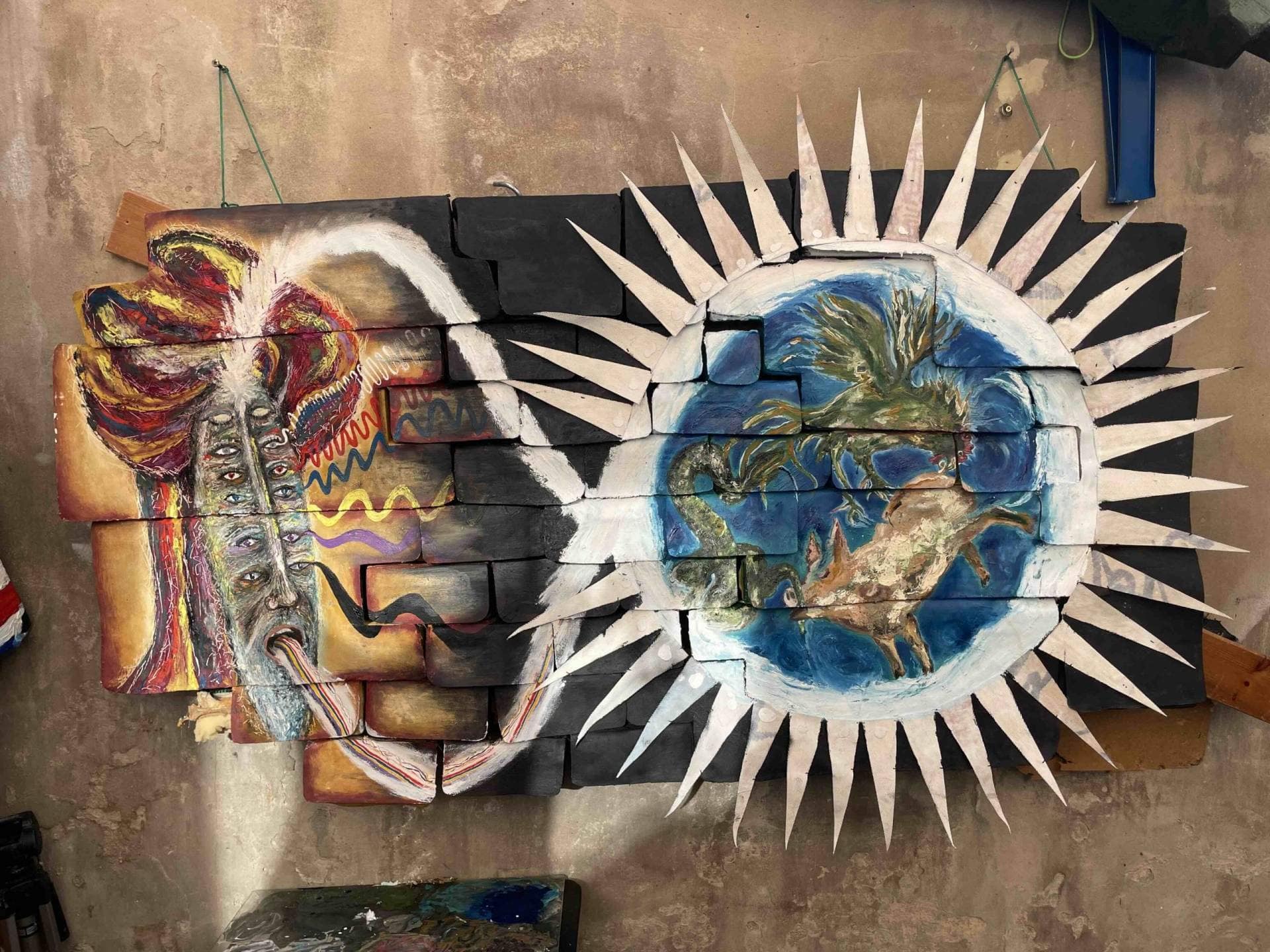
The Omo-Holograma began as a painting and became a game.
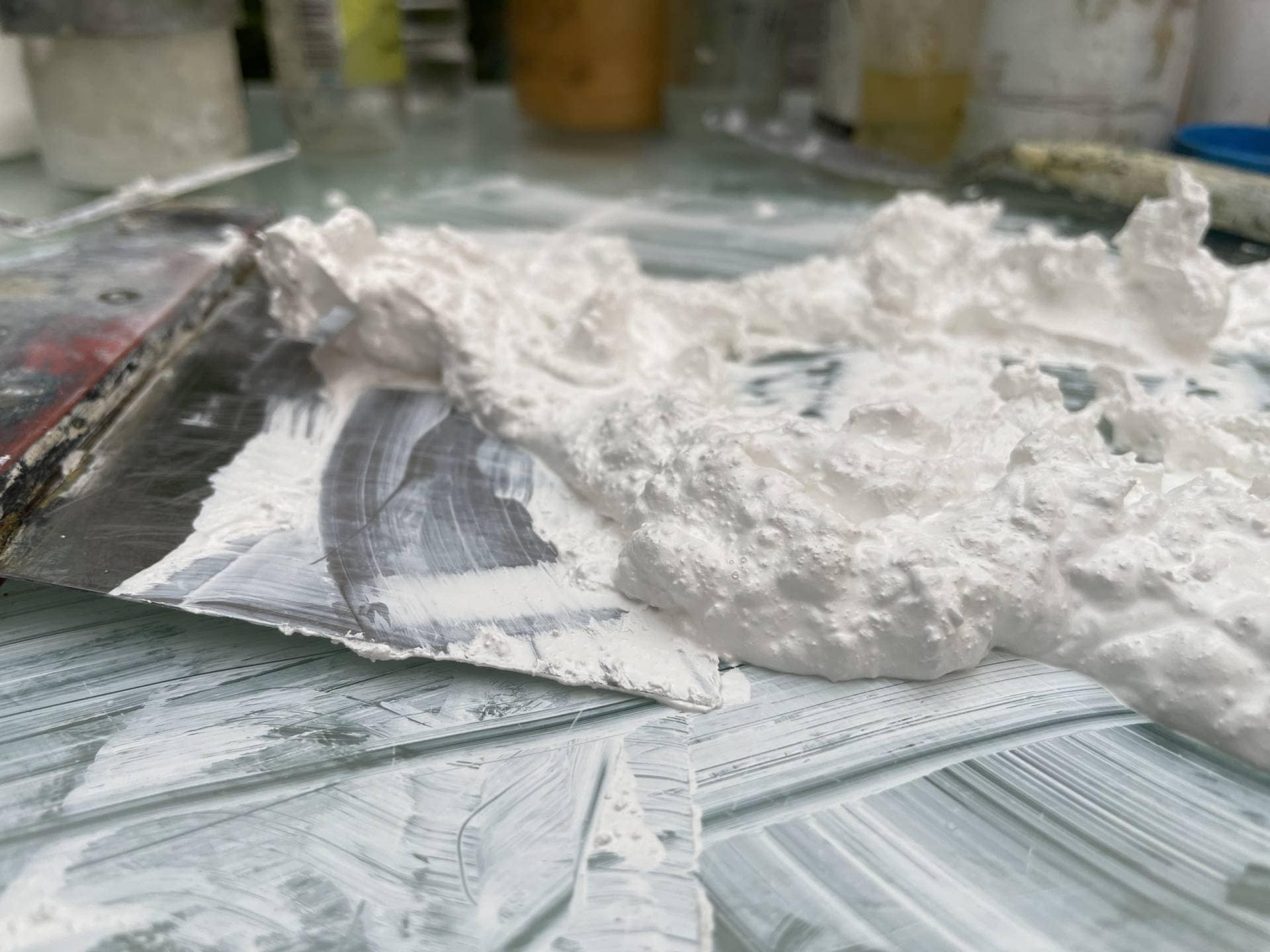
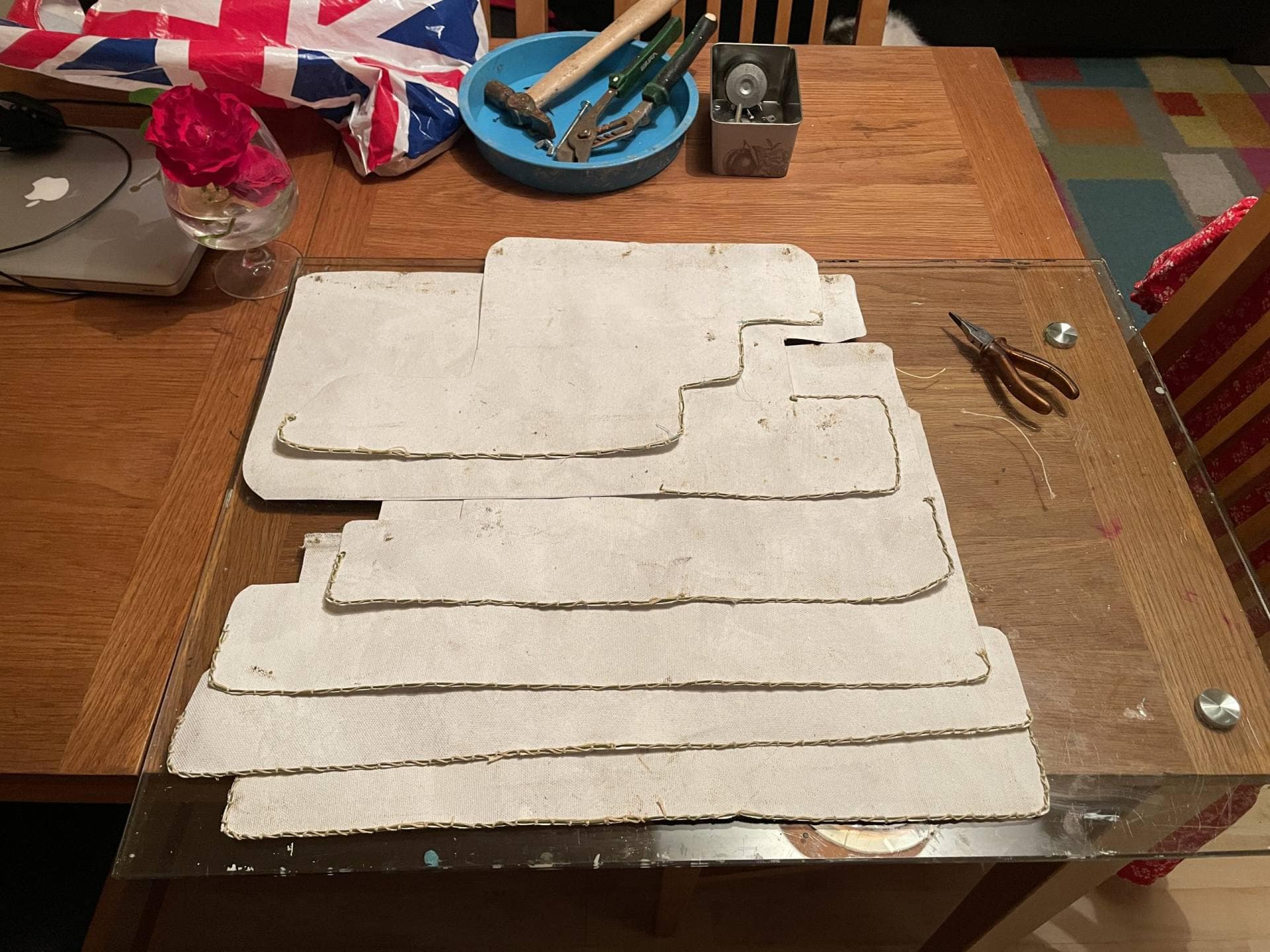
Oil, beeswax and mineral pigments on 36 interconnected canvas stretchers.
81 × 153 × 6 cm (open, flat).
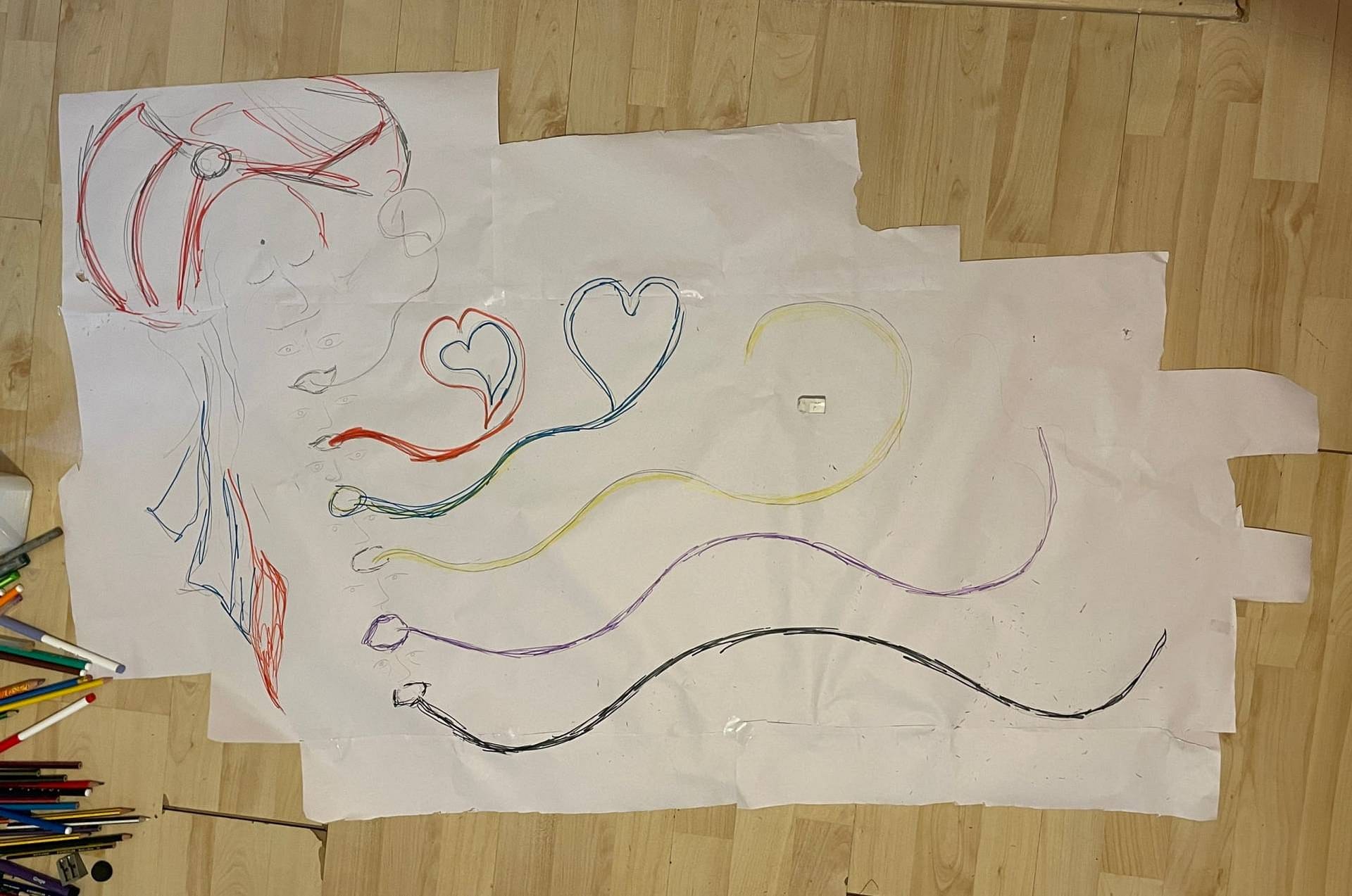
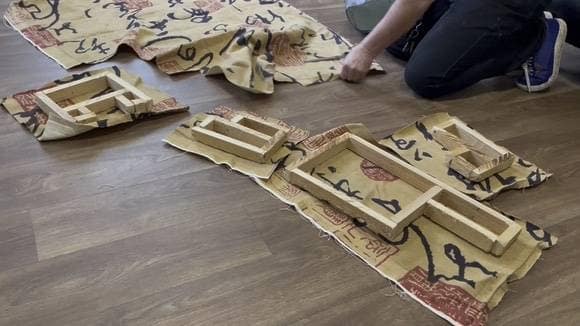
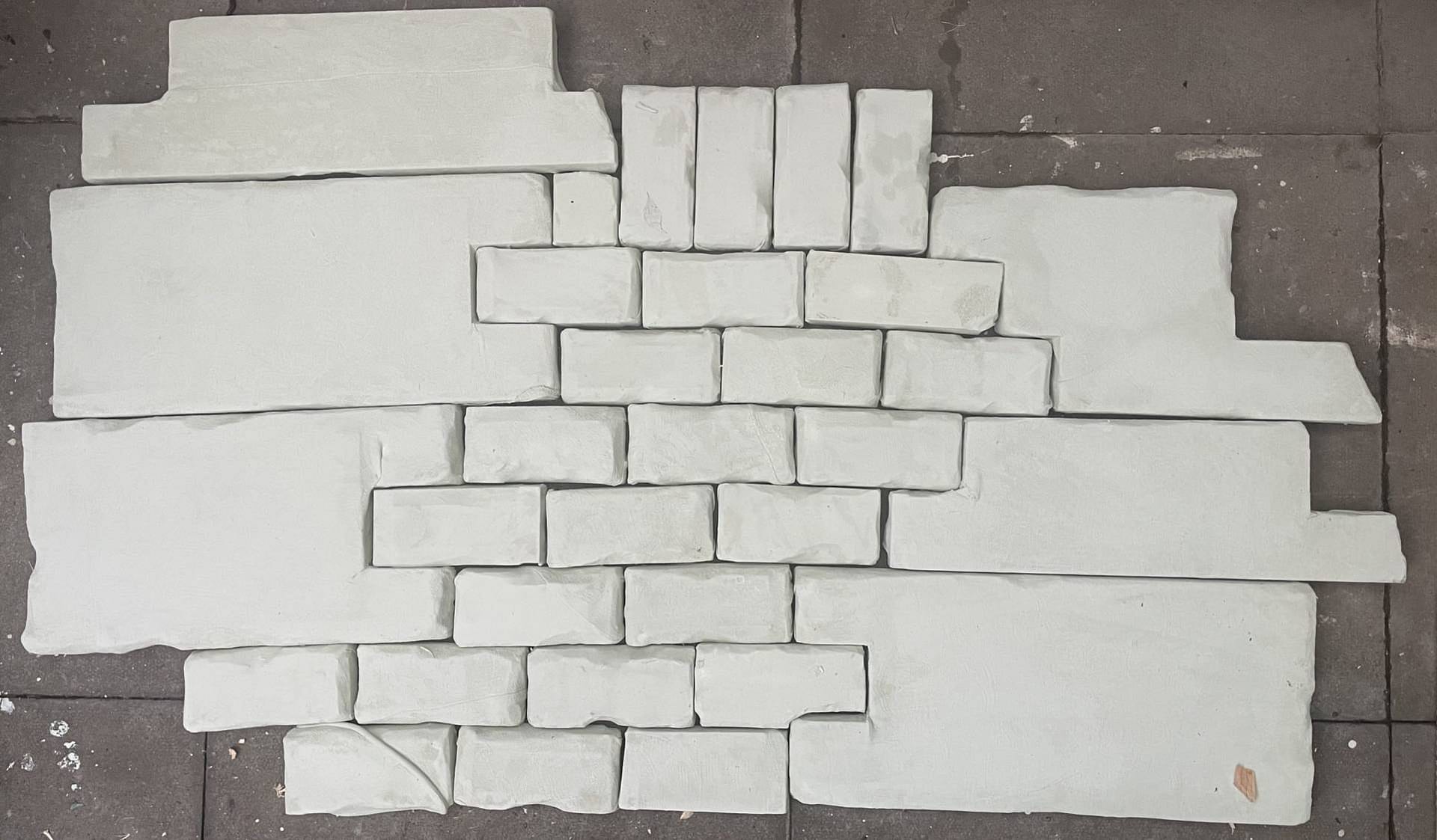
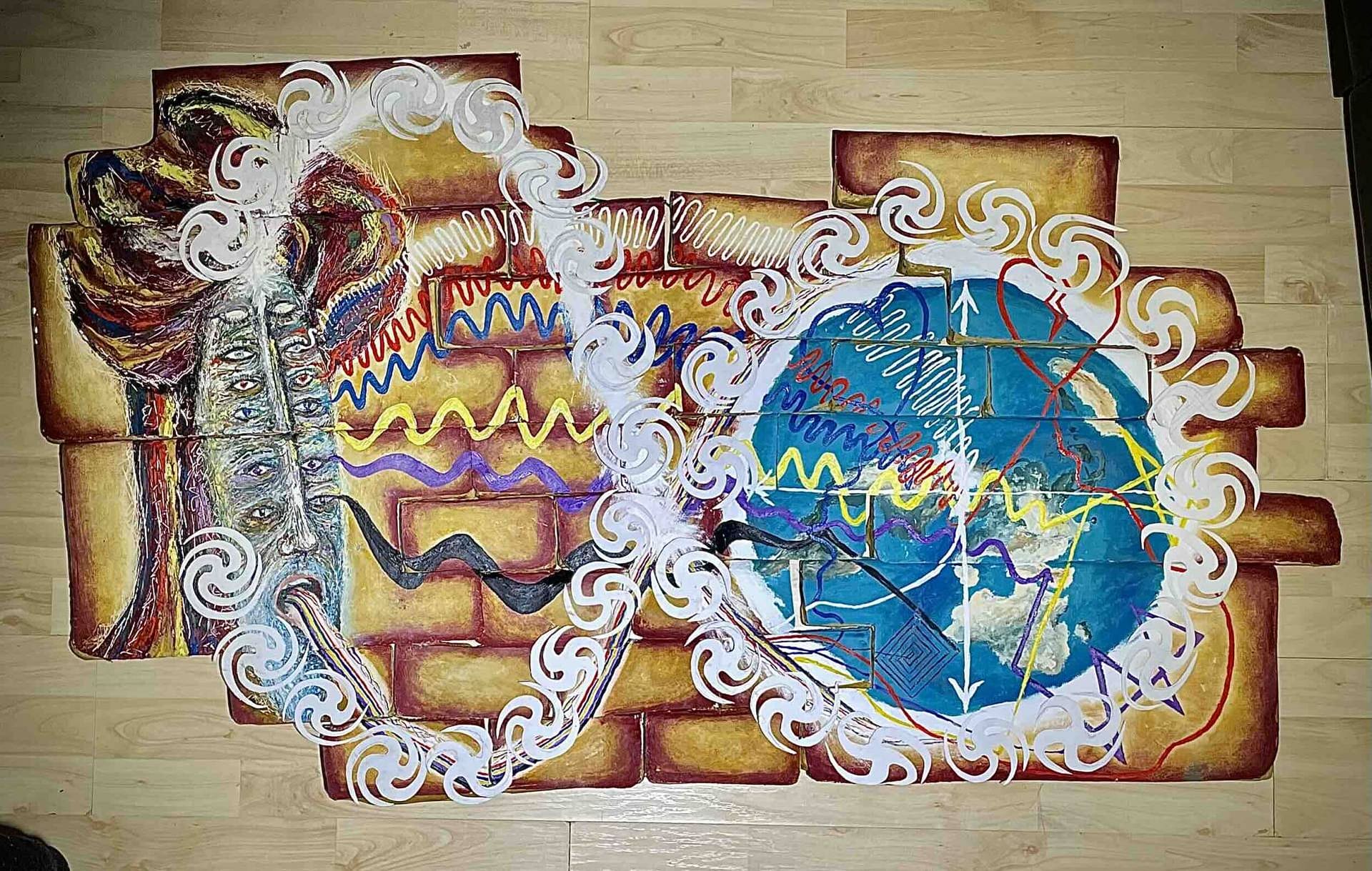
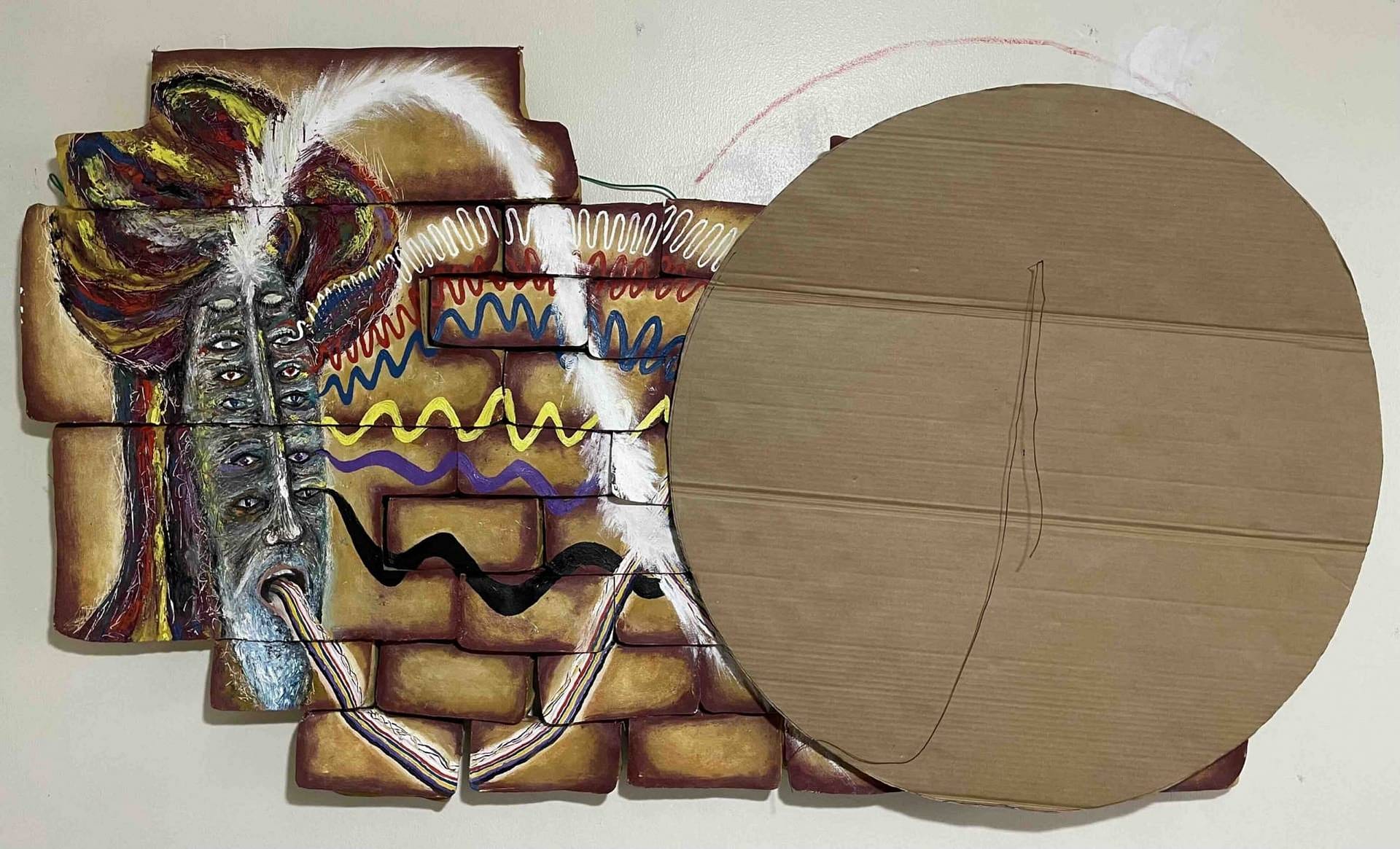
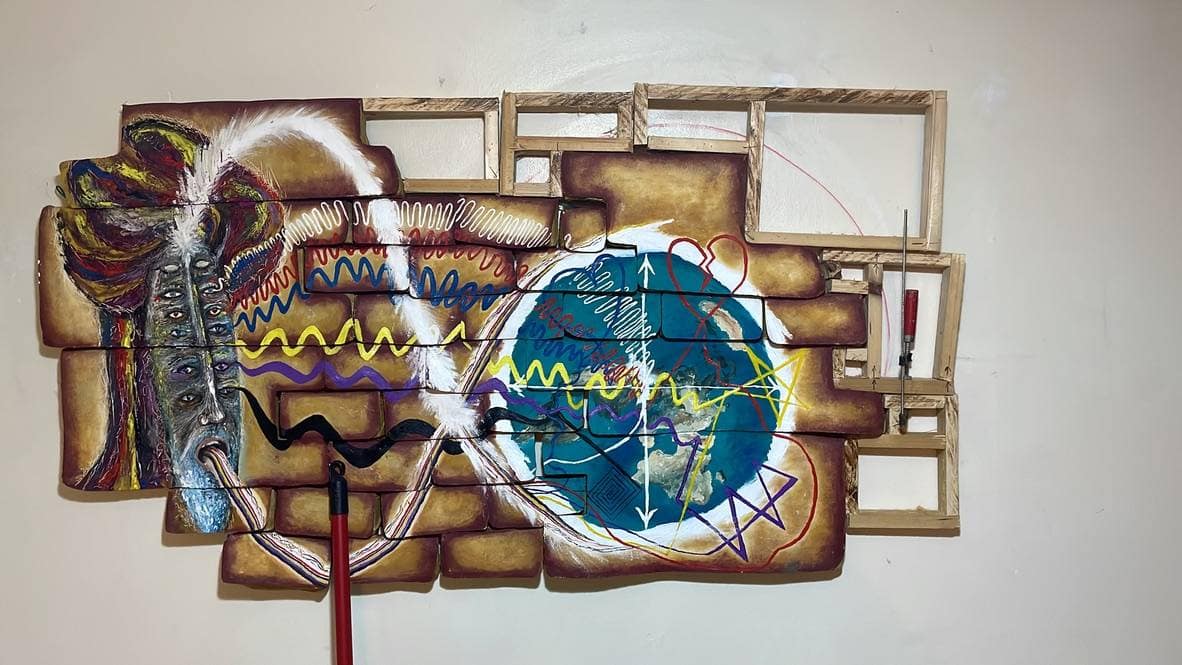
Inspired by the hologram — in which every fragment contains the whole image — the artist built a group of small frames, flexibly interconnected and covered by another piece of fabric, so that each frame would echo the complete composition. Walking past the unfinished painting, he heard an inner voice say, in Spanish: “It’s a game.” Developed with his son Constantino, the work became Samsaragammon, a board game built around the Buddhist wheel of samsara.
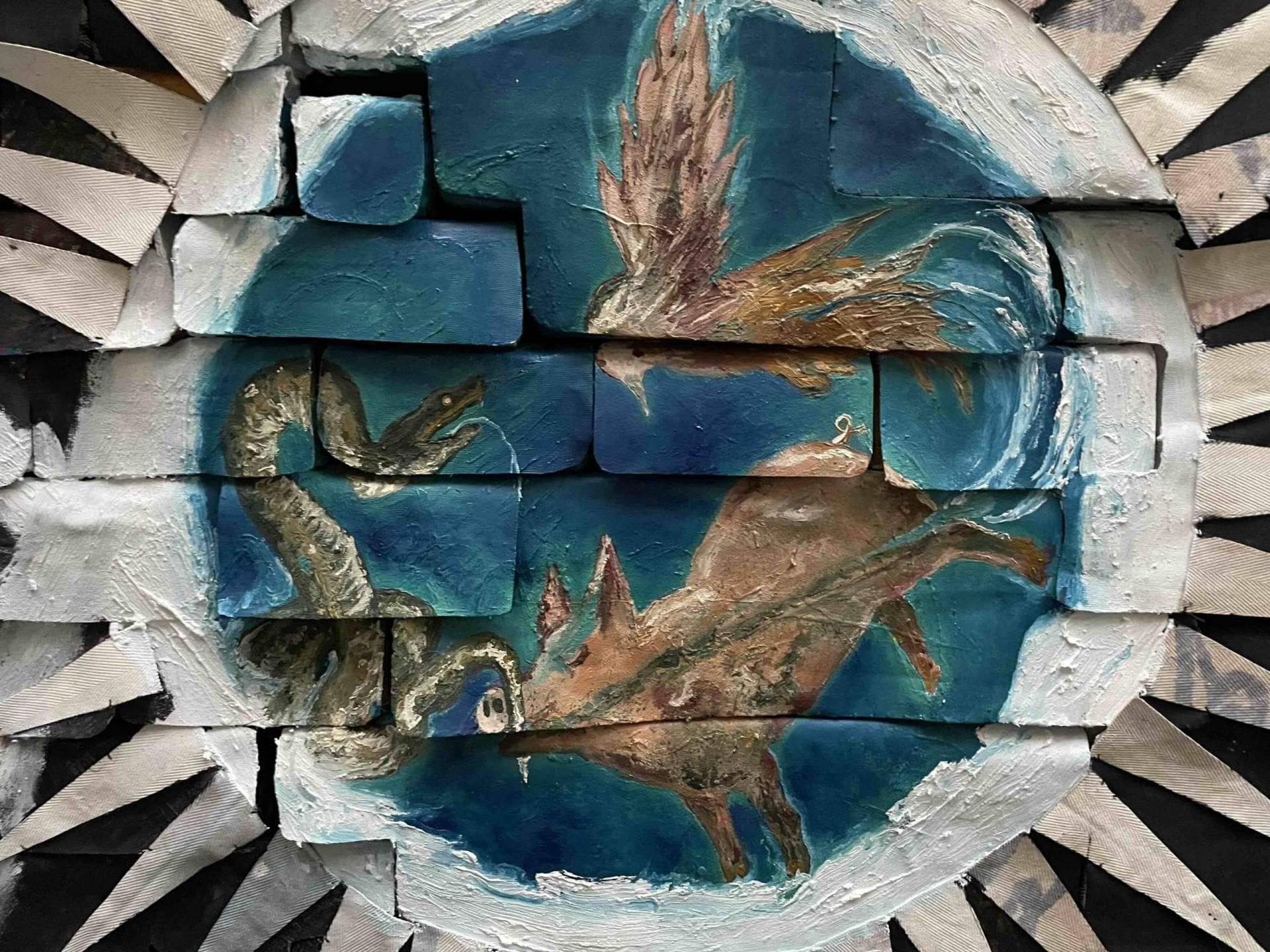
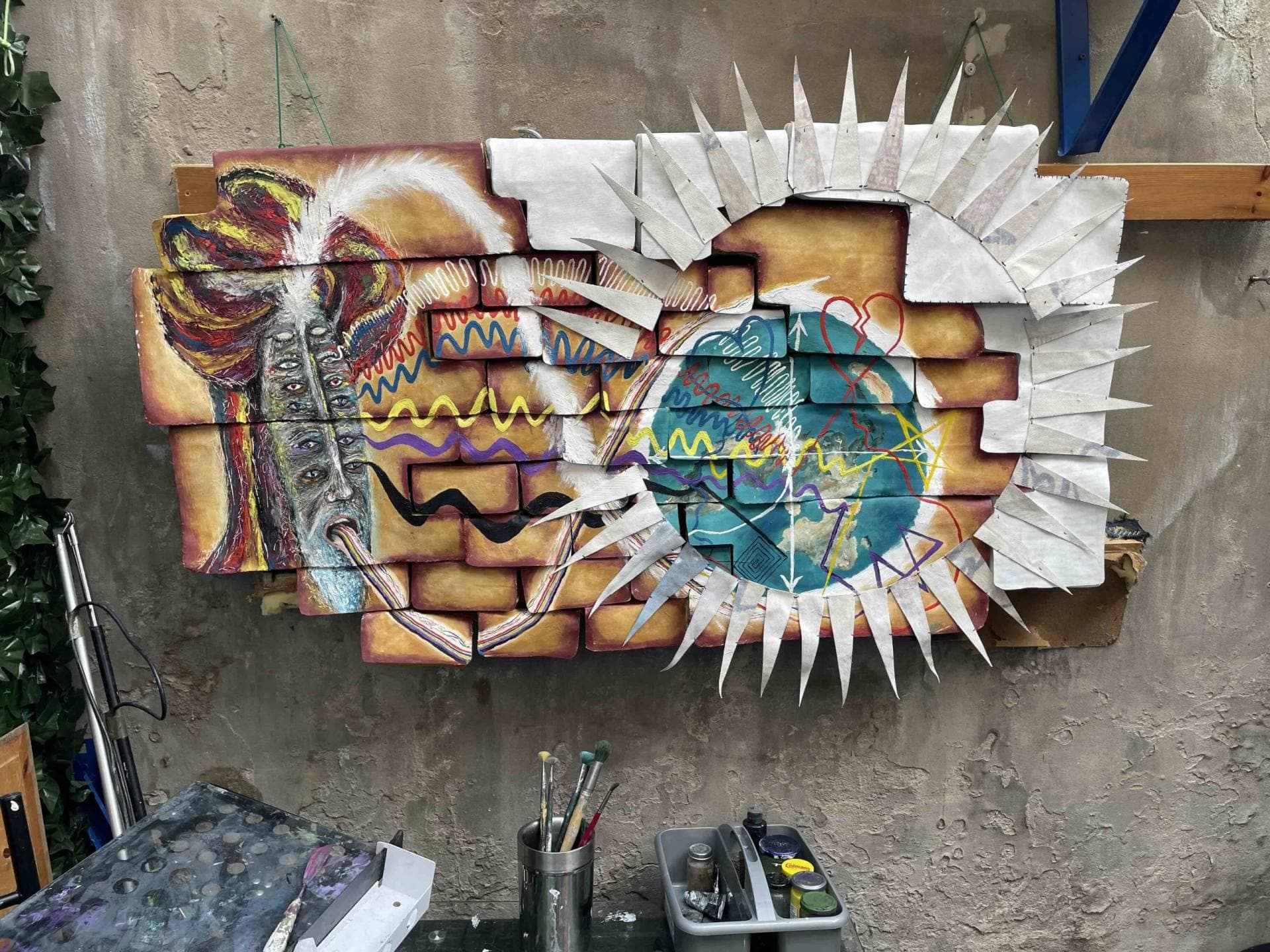
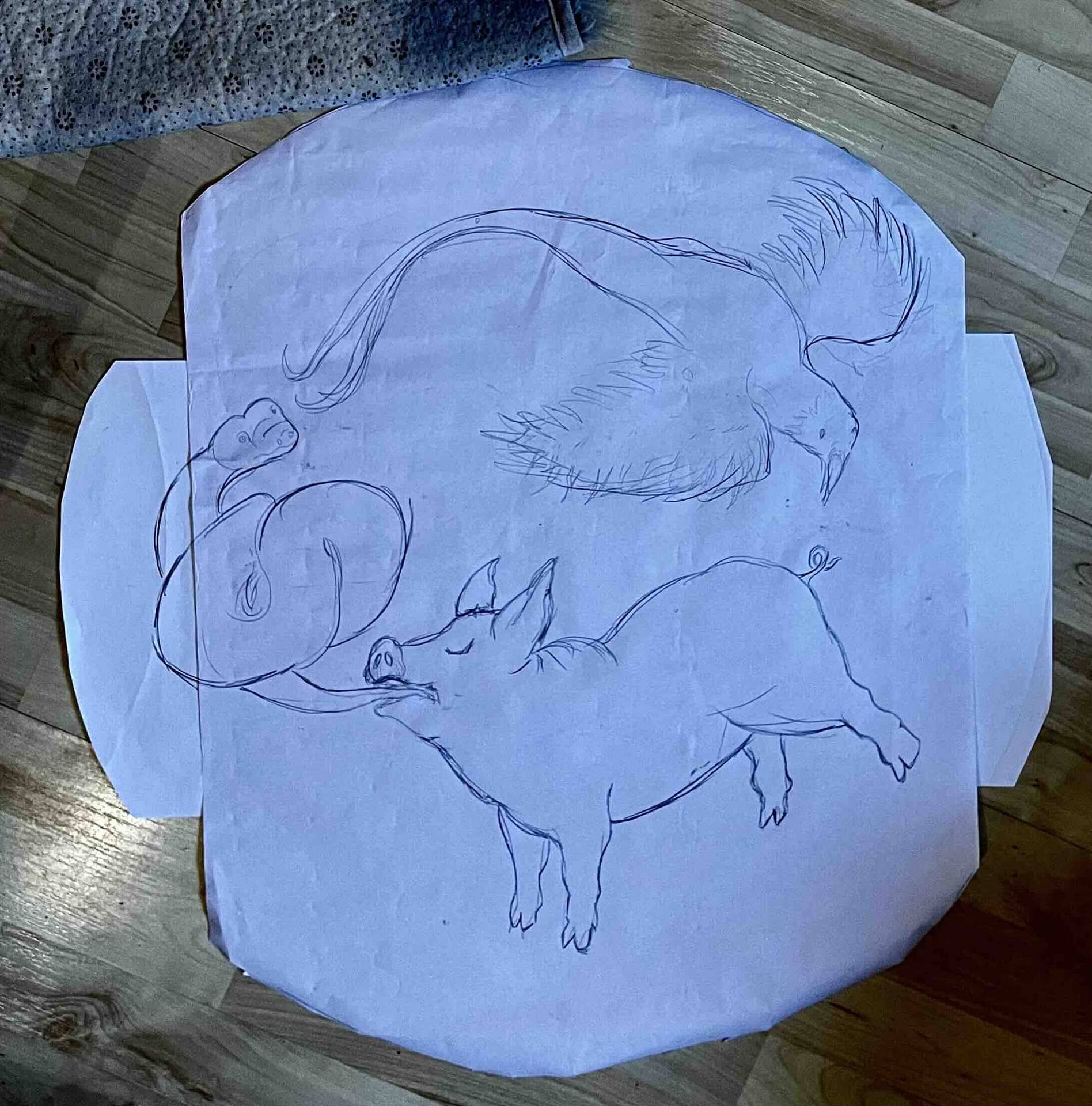
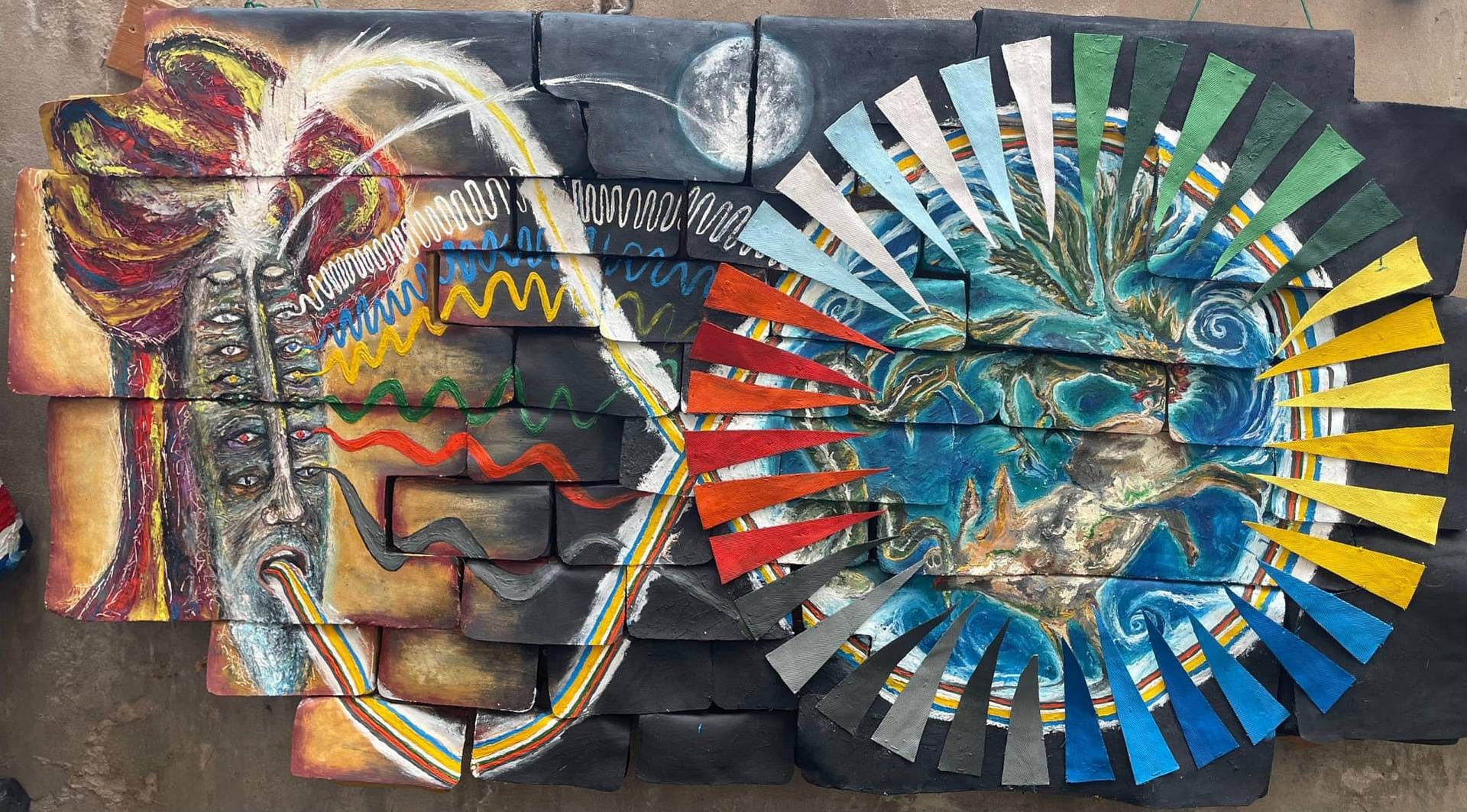
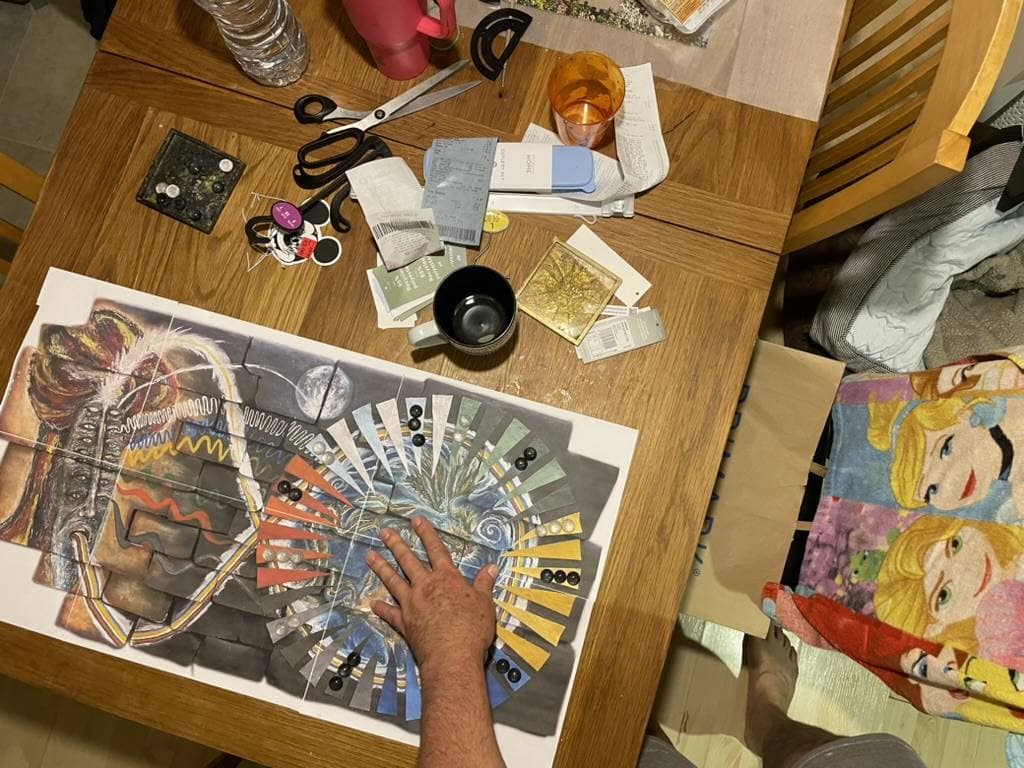
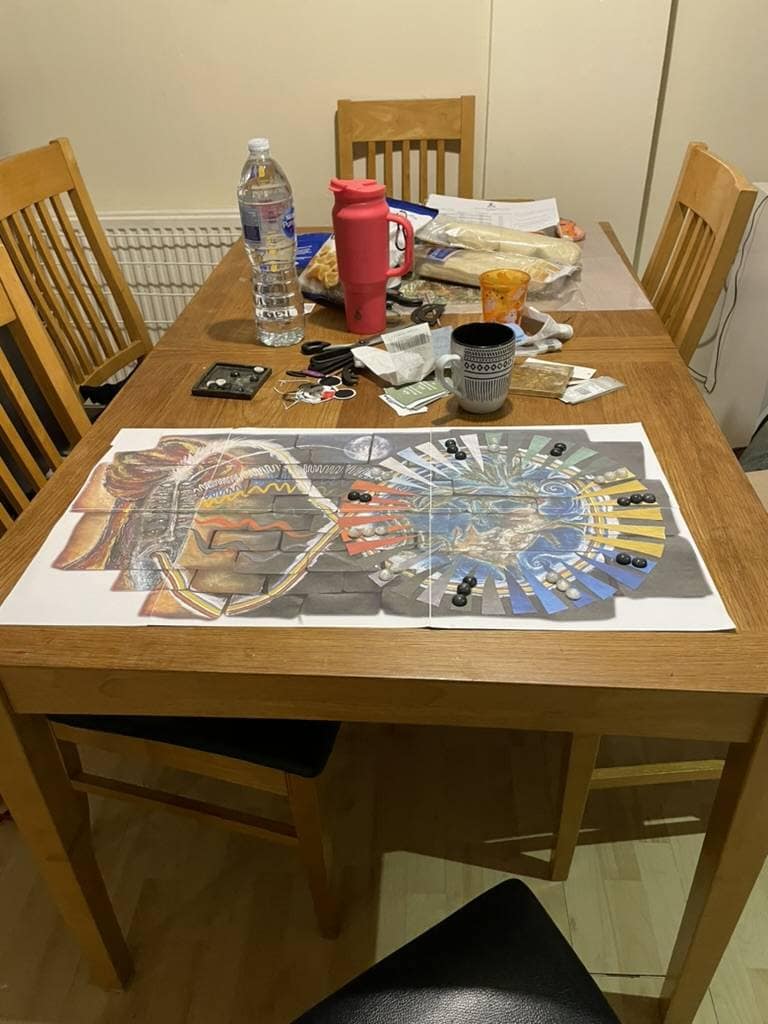
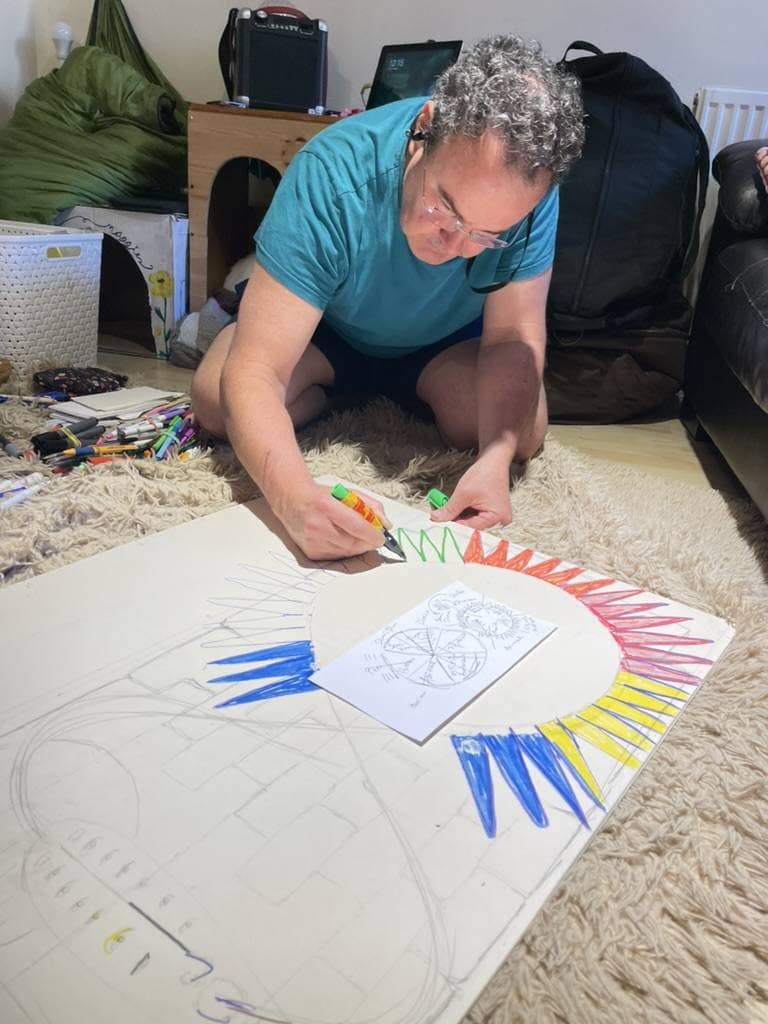
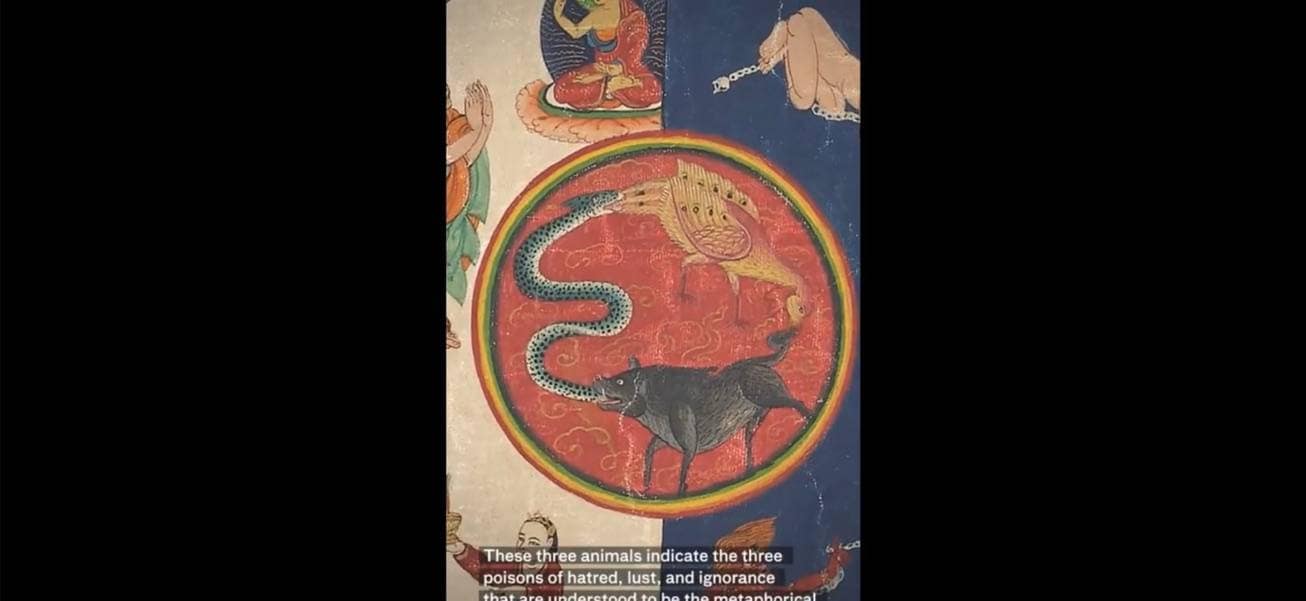
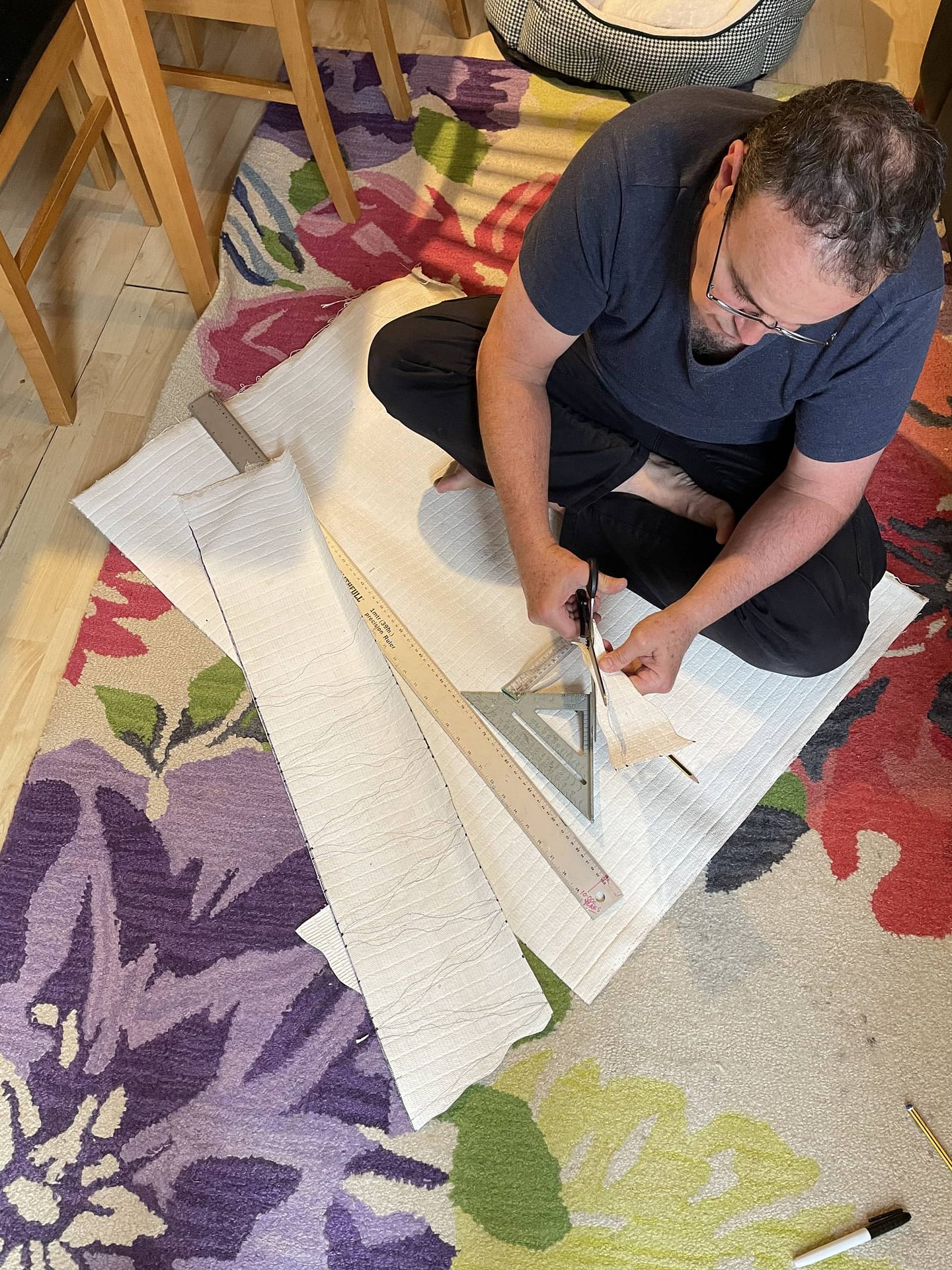
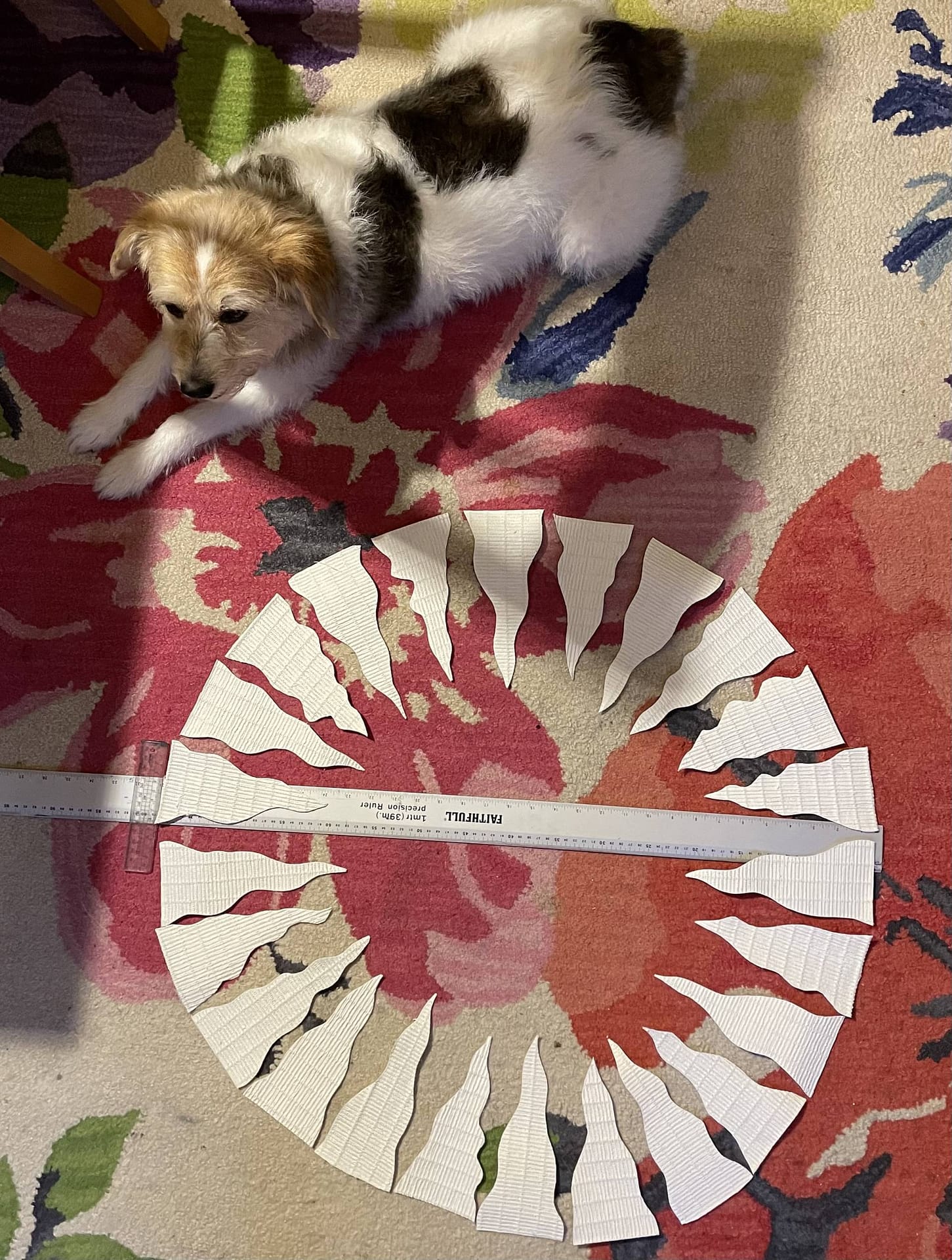


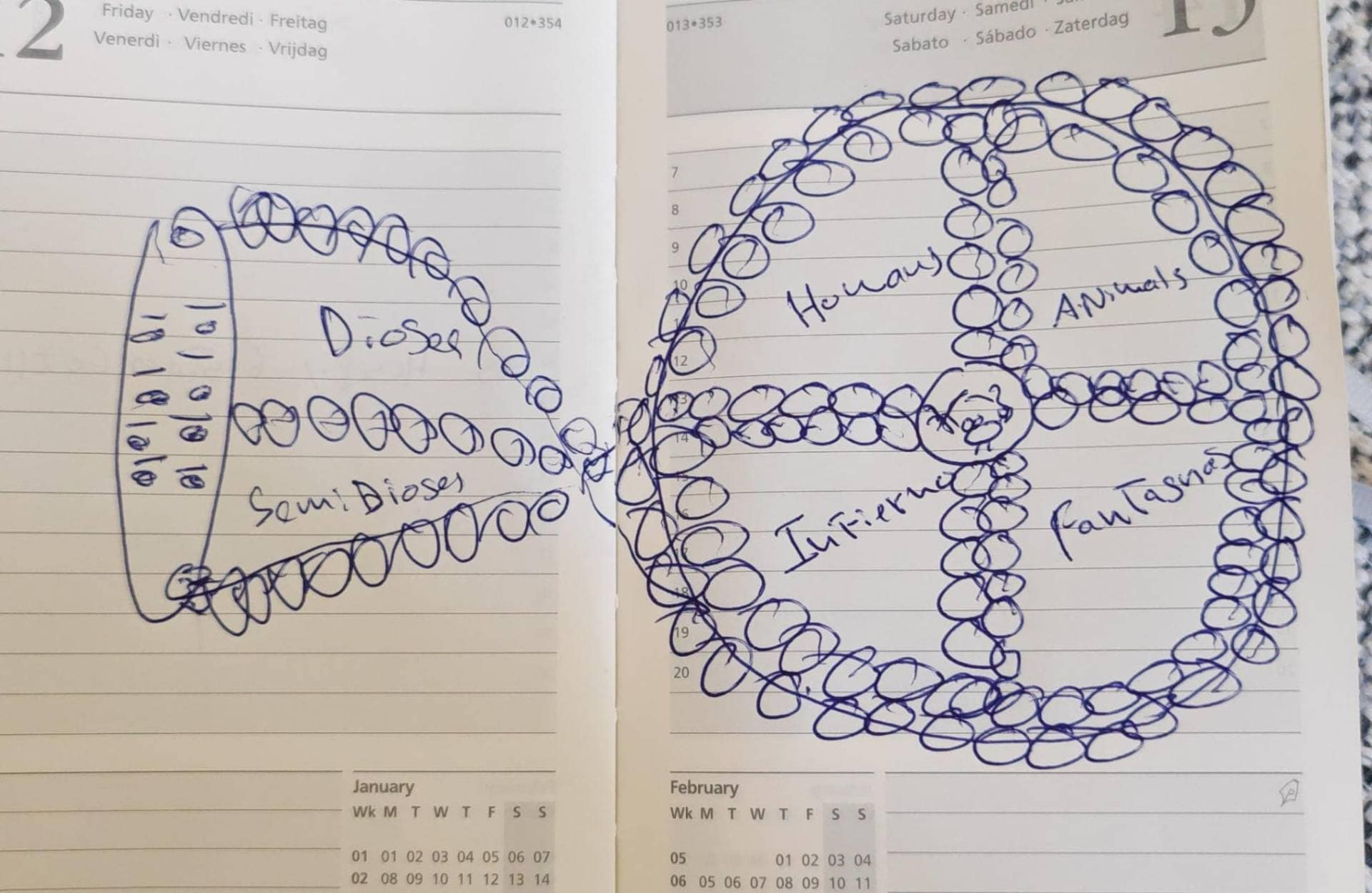
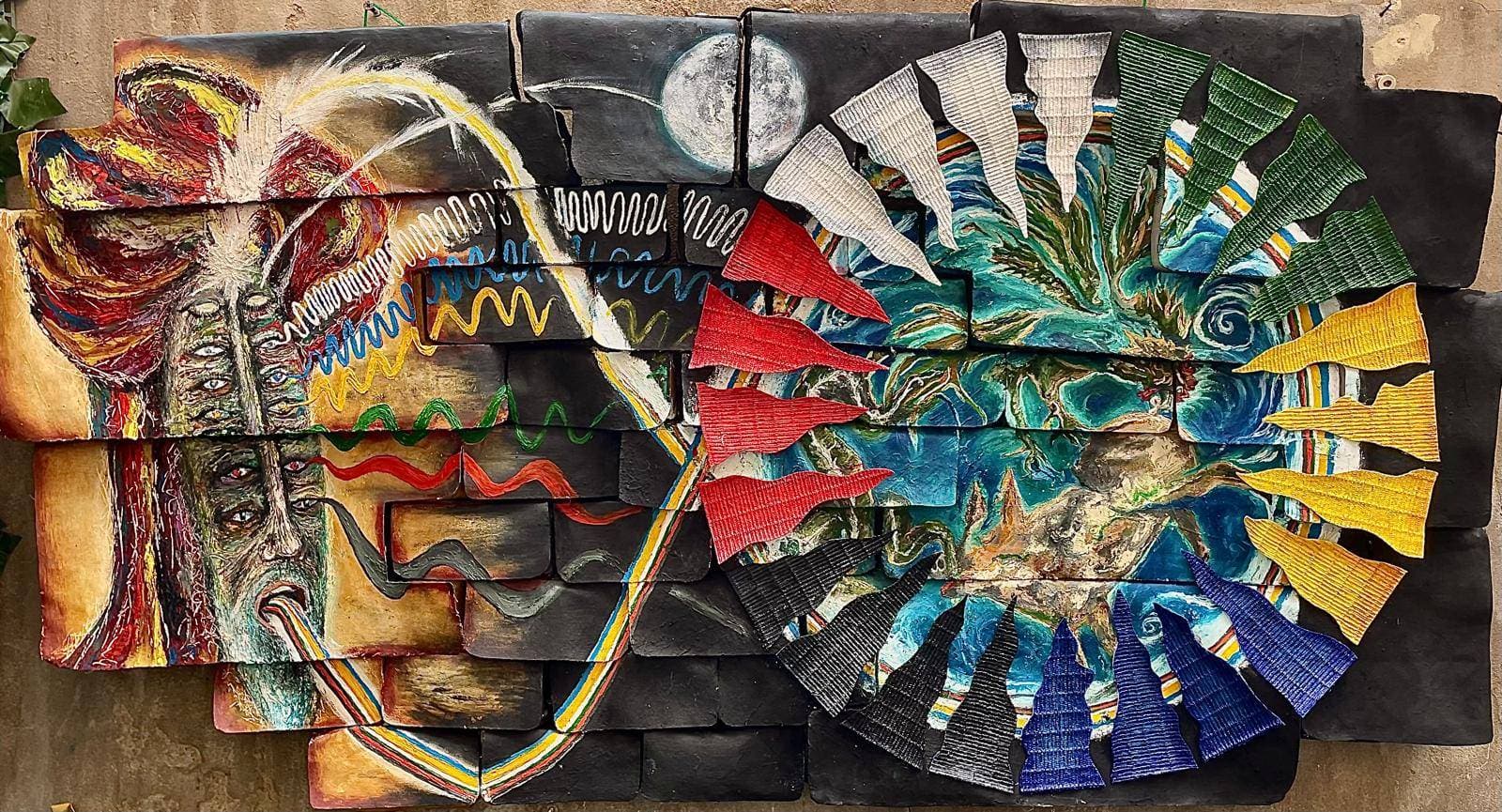



Artist’s statement — The Epiphanic Path of the OmoHologram to Becoming Samsaragammon
When I began this work, I wanted to highlight the remarkable discovery of holography and its profound philosophical and scientific implications. Anyone who understands the true significance of holography may feel disillusioned by the trivialisation of the term, often misused to describe any three-dimensional image. This led me to the concept of a “homo hologram”, emphasising our interconnected reality.
In the 1960s, following the development of the laser, the hologram became a practical reality, building on the work of the Hungarian inventor Dennis Gabor. The American physicist David Bohm was later led to a groundbreaking idea: subatomic particles remain in contact regardless of distance (as seen in “Twin Particles”), because their separation is an illusion. At a deeper level of reality, these particles are not individual entities but extensions of a fundamental WHOLE — a concept known as the “holographic paradigm”.
Holograms are captivating due to their colourful and realistic three-dimensionality. Still, their most impressive feature is this: if a hologram of a rose is cut in half and illuminated with a laser, each half will still contain the entire image of the rose. Inspired by this beautiful reality, I created a tribute using a group of small frames, each flexibly interconnected and covered by another piece of fabric. When the painting is complete, each frame will mimic the entire image, reflecting the holographic principle described in the rose experiment.
So why did I change everything? I was passing by the painting and turned to look at it when I heard an inner voice telling me in perfect Spanish: IT’S A GAME. I started to create different possibilities for games. I shared the idea with my son Constantino, and we worked with many options, looking for one that would be fun. That’s why the OmoHologram became the Samsaragammon. So everything stayed in the family.

The Curvist Manifesto
Curvism proposes that the geometry around us is not neutral. For most of human history, shelter followed organic forms; the right angle is a recent arrival. These paintings are the artist’s answer in matter: instead of describing a softer architecture, they physically bend the corners they occupy.
The research behind Curvism — its biological, historical and psychological hypotheses — is set out in three pillars.
Break the square.
Expand the possible.
Federico García Sala · Curvism